
Creality Ender 3 V3 SE
4.9Editor score
250mm/s High-Speed Printing
CR Touch Auto Leveling
Dual Z-axis Linear Shafts
This guide compares the top 3D printer for beginners in October 2026, evaluating speed, ease of use, build quality, and support to help you choose the right
Finding the right 3D printer for beginners can feel overwhelming with so many options on the market. You need a machine that balances ease of use with reliable performance to ensure your first prints succeed without frustration.
We analyzed ten top-rated models based on setup time, calibration features, print speed, and community support. Our comparison focuses on devices designed to minimize manual adjustments and maximize creative output for new users.
Each pick below highlights key strengths and potential trade-offs to help you decide based on your specific needs. Keep in mind that prices and availability change frequently, so verify current details before purchasing.
4.9Editor score

4.7Editor score

4.2Editor score
This side-by-side comparison highlights the core specifications and unique features of each printer to help you quickly identify which model aligns with your specific budget and project requirements.




The Bambu Lab A1 stands out as the top choice for beginners due to its exceptional ease of use and high performance. With a rating of 4.7 stars, it delivers precise prints with minimal user intervention.
We may earn a commission when you buy through this link, at no additional cost to you.
Its Full-Auto Calibration handles bed leveling and Z-offset automatically, ensuring flawless first layers every time. The active flow rate compensation algorithm adjusts extrusion dynamically for smooth and accurate prints.
While it offers great speed and precision, the base model does not include the AMS Lite for multi-color printing, which must be purchased separately. Additionally, the build volume is smaller compared to industrial machines.
This printer is ideal for hobbyists who want a reliable, plug-and-play experience without spending hours troubleshooting. Its quiet operation and user-friendly design make it perfect for home or office environments.
The A1 takes care of calibration processes automatically, saving you time and frustration during setup and between prints.
Active flow rate compensation ensures consistent extrusion by adjusting based on real-time readings for flawless results.
We may earn a commission when you buy through this link, at no additional cost to you.
The Creality Ender 3 V3 SE offers exceptional value with a 4.9-star rating and comes bundled with four packs of PLA filament. It supports fast printing up to 250mm/s while maintaining quality.
We may earn a commission when you buy through this link, at no additional cost to you.
Its upgraded Sprite direct extruder provides reliable feeding for various materials like PLA and PETG. The CR Touch auto leveling and strain sensors eliminate manual adjustments for consistent success.
While it is highly capable, the initial setup might require more effort than fully assembled models. The interface is functional but less polished than premium competitors.
This bundle is perfect for budget-conscious beginners who want to start printing immediately with included materials. Its strong community support ensures help is available for any customization needs.
The printer saves time with 250mm/s speeds and 2500mm/s² acceleration without compromising on print quality.
Dual Z-axis lead screws reduce wobbling while Y-axis linear shafts ensure stability over long printing sessions.
We may earn a commission when you buy through this link, at no additional cost to you.
The Bambu Lab P1S Combo delivers premium features with a fully enclosed design and multi-color printing via the AMS system. It supports speeds up to 500mm/s and acceleration up to 20,000mm/s².
We may earn a commission when you buy through this link, at no additional cost to you.
Its enclosed body improves performance with advanced filaments like ABS and ASA, which require stable temperatures. Automatic bed leveling ensures high-quality prints with minimal user intervention.
The price is higher than entry-level models, but the included AMS enables vibrant designs without manual color changes. Assembly is quick, taking only about 15 minutes to set up.
This model is ideal for creators who want professional-grade output and versatility from the start. It balances speed, quality, and multi-material support effectively for serious beginners.
The AMS supports up to 16 colors, allowing you to bring your designs to life with vibrant multi-color prints.
The fully enclosed body enables reliable printing of temperature-sensitive materials like ABS and ASA.
We may earn a commission when you buy through this link, at no additional cost to you.
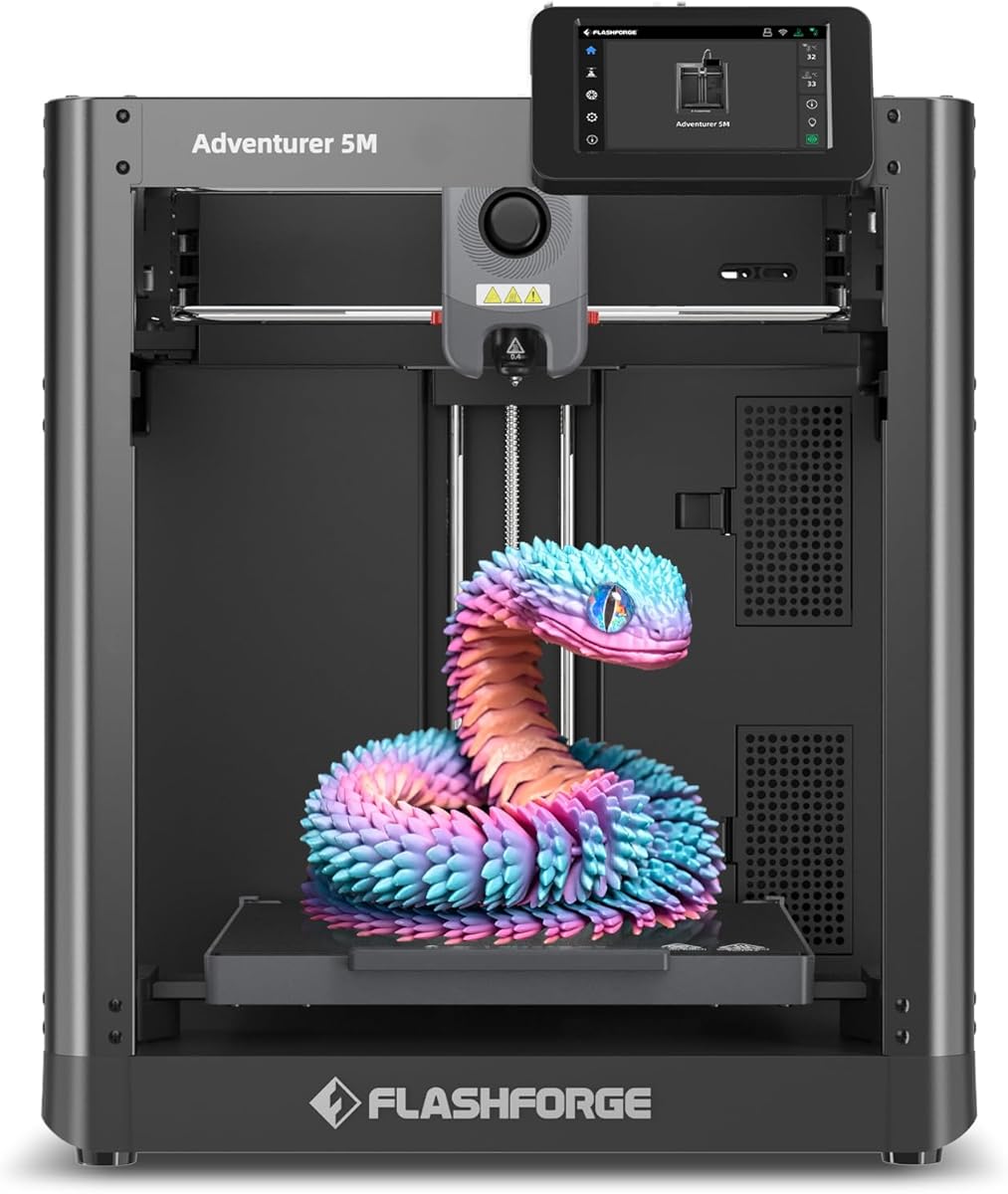
The FLASHFORGE Adventurer 5M focuses on speed with a CoreXY structure capable of 600mm/s travel speeds. It features fully auto leveling and a 280°C direct extruder for efficient printing.
We may earn a commission when you buy through this link, at no additional cost to you.
Its quick 3-second nozzle changes and 35-second warm-up time maximize productivity. The dual-sided PEI platform ensures easy removal of models after printing.
However, its 3.9 rating suggests some users may face reliability or quality issues compared to competitors. The build volume is limited to 220mm in each dimension.
This printer suits those prioritizing speed for prototyping or small batch production. The app monitoring allows remote control, adding convenience for busy users.
The 12X ultra-fast printing reduces production cycles while maintaining precision through vibration compensation.
Optional nozzle sizes from 0.25mm to 0.8mm allow customization for different detail levels and print speeds.
We may earn a commission when you buy through this link, at no additional cost to you.
This mini printer is designed for kids and beginners with a complete starter kit including filament and accessories. It features high precision at 0.01mm and speeds up to 250mm/s.
We may earn a commission when you buy through this link, at no additional cost to you.
Automatic nozzle cleaning and one-touch filament loading simplify operation for users with no prior experience. The PEI heated bed ensures easy model removal.
Its compact size limits the size of projects but makes it ideal for small toys or desktop decorations. The 30-day return policy and lifetime support offer peace of mind.
Perfect for schools or homes where space is limited, this printer encourages creativity with minimal setup. Its friendly warranty ensures long-term usability without extra costs.
One-button auto-leveling and one-touch filament loading simplify setup for users with no technical background.
Lifetime professional technical support and a 12-month free repair service ensure issues are resolved quickly.
We may earn a commission when you buy through this link, at no additional cost to you.
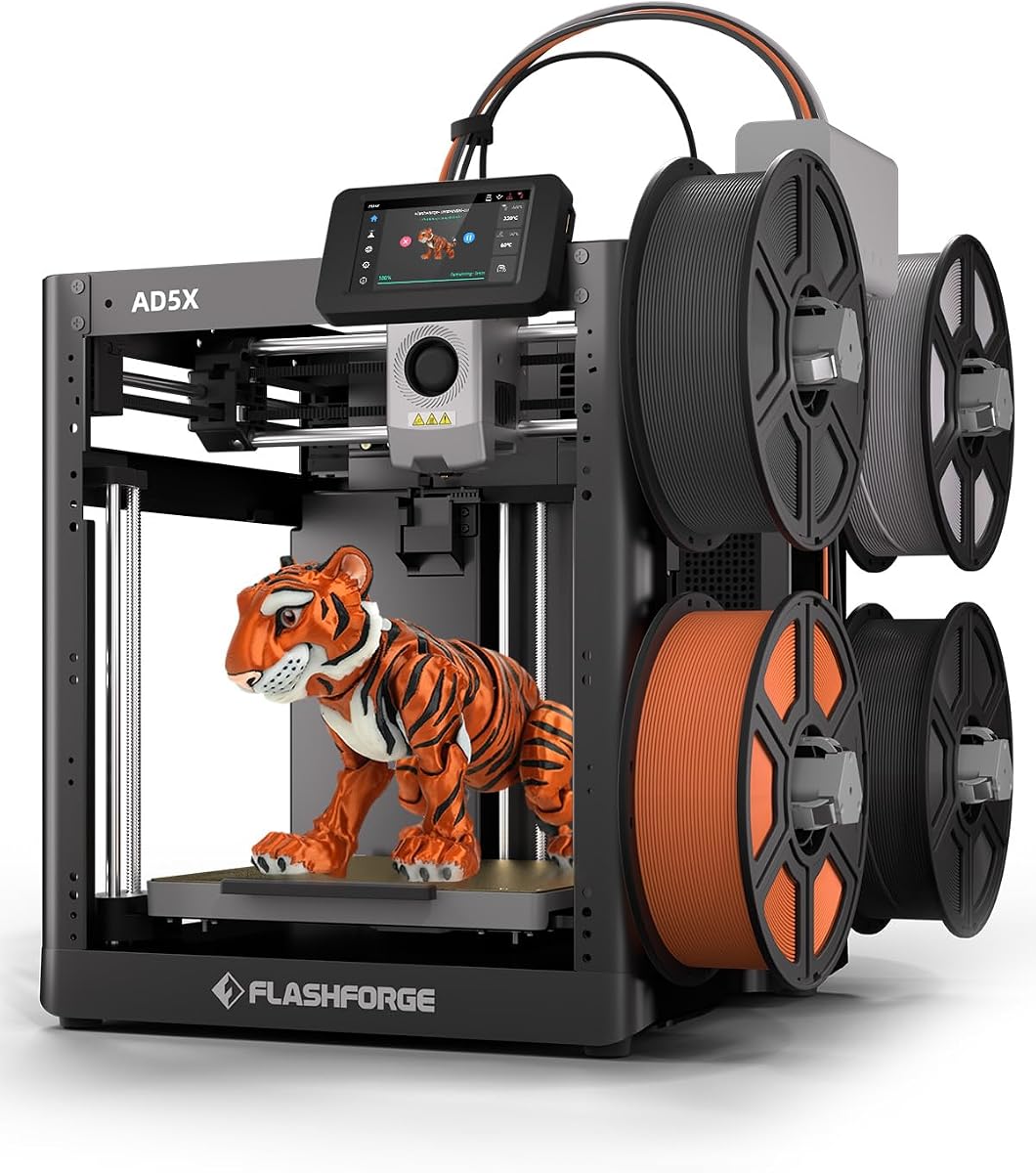
The FLASHFORGE AD5X brings multi-color capabilities to beginners with up to 4 colors simultaneous printing. It uses a CoreXY structure for speeds up to 600mm/s with 20,000mm/s² acceleration.
We may earn a commission when you buy through this link, at no additional cost to you.
Its dual-channel cooling fan and vibration compensation enhance print quality. The resume printing function handles power losses, saving time and material.
While the rating is lower, its features are competitive for the price. Users may need to learn how to manage multi-color setups effectively.
This printer is suitable for those wanting to experiment with color without expensive multi-color systems. The mobile app allows remote control for added convenience.
Vivid multi-color printing supports up to 4 colors simultaneously, giving you endless creative possibilities.
Versatile nozzle options from 0.25mm to 0.8mm allow optimization for detail or speed as needed.
We may earn a commission when you buy through this link, at no additional cost to you.
The AOSEED AI 3D Printer uses AI to simplify design with voice or image prompts. It features an enclosed safe design and speeds up to 400mm/s for quick projects.
We may earn a commission when you buy through this link, at no additional cost to you.
Kids can access 8,000+ models and create custom designs with AI MiniMe or Doodle tools. The built-in camera allows parents to monitor progress in real time.
It is limited to single-color printing, so multi-color designs require manual assembly. However, the AI integration makes design accessible without CAD skills.
This printer is perfect for families focused on STEM education and creative play. Its safety features and ease of use make it a thoughtful gift for children.
With AI Doodle and MiniMe, children can create custom 3D models without any prior design skills.
Enclosed design and real-time camera monitoring ensure a safe and engaging experience for kids.
We may earn a commission when you buy through this link, at no additional cost to you.
The Bambu Lab A1 mini is a compact option ideal for small projects and home use. It includes an LED lamp kit to turn prints into functional lights.
We may earn a commission when you buy through this link, at no additional cost to you.
Automatic calibration and quiet operation make it user-friendly. The Bambu ecosystem allows access to a large library of ready-to-print models.
Its small build volume limits larger projects, but it is efficient for everyday items. The setup is simple, allowing beginners to start printing quickly.
This printer is recommended for those wanting a reliable, easy-to-use device for small creative projects. It balances quality and simplicity effectively for hobbyists.
The included LED lamp kit lets you turn 3D creations into functional decorative lights easily.
Access MakerWorld for ready-to-print models and manage prints via the Bambu Handy app.
We may earn a commission when you buy through this link, at no additional cost to you.
The FLASHFORGE AD5M combines high speed with ease of use through fully auto calibration. It features a CoreXY structure for reliable performance at 600mm/s.
We may earn a commission when you buy through this link, at no additional cost to you.
The quick-swap nozzle allows changes in seconds, reducing maintenance time. Resume functionality saves prints after power losses, adding convenience for long jobs.
While the build volume is standard, the speed makes it efficient for small projects. The Orca-flashforge slicer aids in managing files and printers.
This model is suitable for those wanting reliable performance without complex setup. Its design ensures steady, quality prints for home and office use.
Tool-free nozzle swaps take as little as 3 seconds, simplifying maintenance for novices and experts.
Resume prints after outages save ongoing layers, preventing wasted time on failed jobs.
We may earn a commission when you buy through this link, at no additional cost to you.
The Bambu Lab P1S is a powerful enclosed printer with speeds up to 500mm/s and acceleration up to 20,000mm/s². It supports advanced filaments like ABS and ASA due to enclosure.
We may earn a commission when you buy through this link, at no additional cost to you.
Automatic bed leveling and setup in 15 minutes make it beginner-friendly. It supports multi-color printing with an optional AMS connection.
While the base model lacks multi-color capability out of the box, its performance is robust. The enclosure ensures consistent temperatures for complex materials.
This printer is ideal for those planning to print with engineering materials. Its reliability and speed offer a professional experience for serious beginners.
True high speed printing with 500mm/s and 20,000mm/s² acceleration lets you create quickly.
Enclosed design supports ABS, ASA, and other advanced filaments requiring stable heat.
We may earn a commission when you buy through this link, at no additional cost to you.
Choosing the right 3D printer involves evaluating features that align with your skill level and project goals. Below are key factors to consider before making a decision.
For beginners, automatic bed leveling and pre-assembled units reduce the initial barrier to entry. Manual calibration can be frustrating and lead to failed prints early on.
Prioritize printers with auto-leveling features to ensure consistent first layers without manual adjustments.
The build volume determines the maximum size of objects you can print in one piece. Larger volumes offer more versatility but cost more and take up more space.
Assess your typical project sizes to select a printer that balances space constraints with creative freedom.
Faster printers save time on large projects, but speed can impact quality if not managed properly. Modern beginner models often balance speed with precision through advanced motion systems.
Look for CoreXY structures and high acceleration ratings for efficient and reliable printing.
Most beginners start with PLA, but some projects may require PETG or ABS. Enclosed printers are necessary for materials sensitive to temperature fluctuations like ABS.
Choose a printer that supports the materials you plan to use as you advance in skill.
A strong community provides troubleshooting help and pre-sliced files for popular models. Good software integration simplifies slicing and printing processes.
Select models with active user bases to ensure long-term assistance and resource availability.
3D printers can be noisy, which may be disruptive in shared living spaces. Quiet motors and dampening features improve the overall user experience.
Consider the environment where the printer will operate to choose a quieter model if needed.
The initial cost is only part of the investment; factor in filament and replacement parts. Bundles with filament or tools offer better value for new users.
Compare total cost of ownership rather than just the sticker price when selecting a printer.
Remote monitoring via apps and cameras allow you to track progress without staying near the printer. This feature adds convenience for unattended printing sessions.
Look for Wi-Fi connectivity and camera options if you want to manage prints remotely.
Start by leveling the bed automatically or manually according to your printer manual before the first print to ensure proper adhesion and print quality.
Use high-quality filament stored in a dry environment to prevent moisture absorption that can lead to clogs and weak prints over time.
Clean the build plate regularly with isopropyl alcohol and check nozzles for residue to maintain consistent performance throughout your printing journey.
The Bambu Lab A1 is widely considered the easiest due to its automatic calibration and user-friendly interface. It minimizes manual adjustments so you can focus on creating instead of troubleshooting.
No, many beginners use pre-made models from online libraries like MakerWorld. If you want to design your own, beginner-friendly software like Tinkercad offers simple learning paths.
Starting with one or two spools of PLA is sufficient for testing and learning. PLA is affordable and easy to use, making it ideal for your first projects.
Enclosed printers help with materials like ABS but are not required for basic PLA printing. They provide better stability but come at a higher cost and footprint.
Some models like the P1S Combo support multi-color printing with an AMS system. Others may require manual color changes or swapping filaments between prints.
Perform basic maintenance such as cleaning the bed and lubricating rods every few months. Check nozzles and belts regularly to prevent issues from arising unexpectedly.
The Bambu Lab A1 leads our list with its perfect blend of automation and performance for new users. The Creality Ender 3 V3 SE offers incredible value for those watching their budget closely.
Consider your primary needs such as speed, material support, or ease of use when narrowing down options. Each printer has unique strengths tailored to different beginner preferences and project scopes.
Remember to check current prices and availability before purchasing as these can fluctuate frequently. Investing in a printer that matches your current needs ensures a rewarding introduction to 3D printing.