
SUNLU S1 Plus Filament Dryer, White
4.7Editor score
Quiet operation under 10dB
Handles 1.75 to 3mm filament
Clear LCD temperature display
Compare the top 3D Printer Filament Dryer Box options to eliminate moisture issues and ensure consistent print quality across various filament types.
Finding the right 3D Printer Filament Dryer Box is crucial for anyone serious about quality results. Moisture absorbs into filament quickly, causing stringing and clogs. A good dryer box keeps your material dry during printing and storage.
We compared ten leading models based on heating speed, capacity, sealing quality, and ease of use. Our analysis covers budget options to premium units with advanced sensors. Each product was evaluated against common printing challenges and user needs.
Each pick shows specific strengths like dual chambers or fast heating cycles. Prices and stock change frequently so check current listings before buying. We aim to help you choose the best solution for your specific printing setup and environment.
4.7Editor score

4.6Editor score

4.7Editor score
This table provides a quick side-by-side look at the key specifications and features of all ten models. It helps you identify which box fits your spool size, filament type, and budget requirements without reading every detail.



The Creality Space Pi X4 stands out as a robust solution for users with large filament collections. It holds up to four standard 1kg spools comfortably and provides dual heating chambers for efficient moisture removal.
We may earn a commission when you buy through this link, at no additional cost to you.
This unit uses two independent 200W heaters that can reach up to 85 degrees Celsius. This allows it to handle high-performance materials like ABS and PC effectively. The touch interface makes setting specific drying parameters straightforward and clear.
While the price is higher than basic models, the efficiency and capacity justify the cost for serious makers. The only downside is the physical size which requires more desk space than single spool units.
Buy this if you print often with multiple filaments or need to dry high-temp materials reliably. It extends filament shelf life and reduces waste by ensuring consistent moisture levels before printing.
Dual heating chambers remove moisture thirty percent faster than single chamber dryers ensuring quicker turnaround times for your projects.
With a range up to eighty five degrees this box can handle delicate PLA as well as demanding engineering filaments like Polycarbonate.
We may earn a commission when you buy through this link, at no additional cost to you.
The SUNLU S4 is designed for advanced users who need to manage multiple filament streams simultaneously. It can connect to up to four printers at once making it ideal for multi-color or multi-machine workflows.
We may earn a commission when you buy through this link, at no additional cost to you.
With a powerful 350W heater and three internal fans it maintains a tight temperature balance within three degrees. The auto humidity control feature starts and stops drying based on real time readings keeping filament consistently dry without waste.
The price reflects its advanced capabilities and large capacity. Setting up for four printers requires careful planning but the system is stable and safe with triple security layers protecting against overheating.
This dryer is perfect for workshops or serious enthusiasts printing complex jobs. It ensures every spool is ready and dry which is critical for maintaining quality across long multi-color prints.
Connects to four printers at once allowing simultaneous drying while you run complex multi-color or multi-part production batches effortlessly.
Auto humidity control activates drying only when needed to prevent over-drying and preserve the long term integrity of your filament spools.
We may earn a commission when you buy through this link, at no additional cost to you.
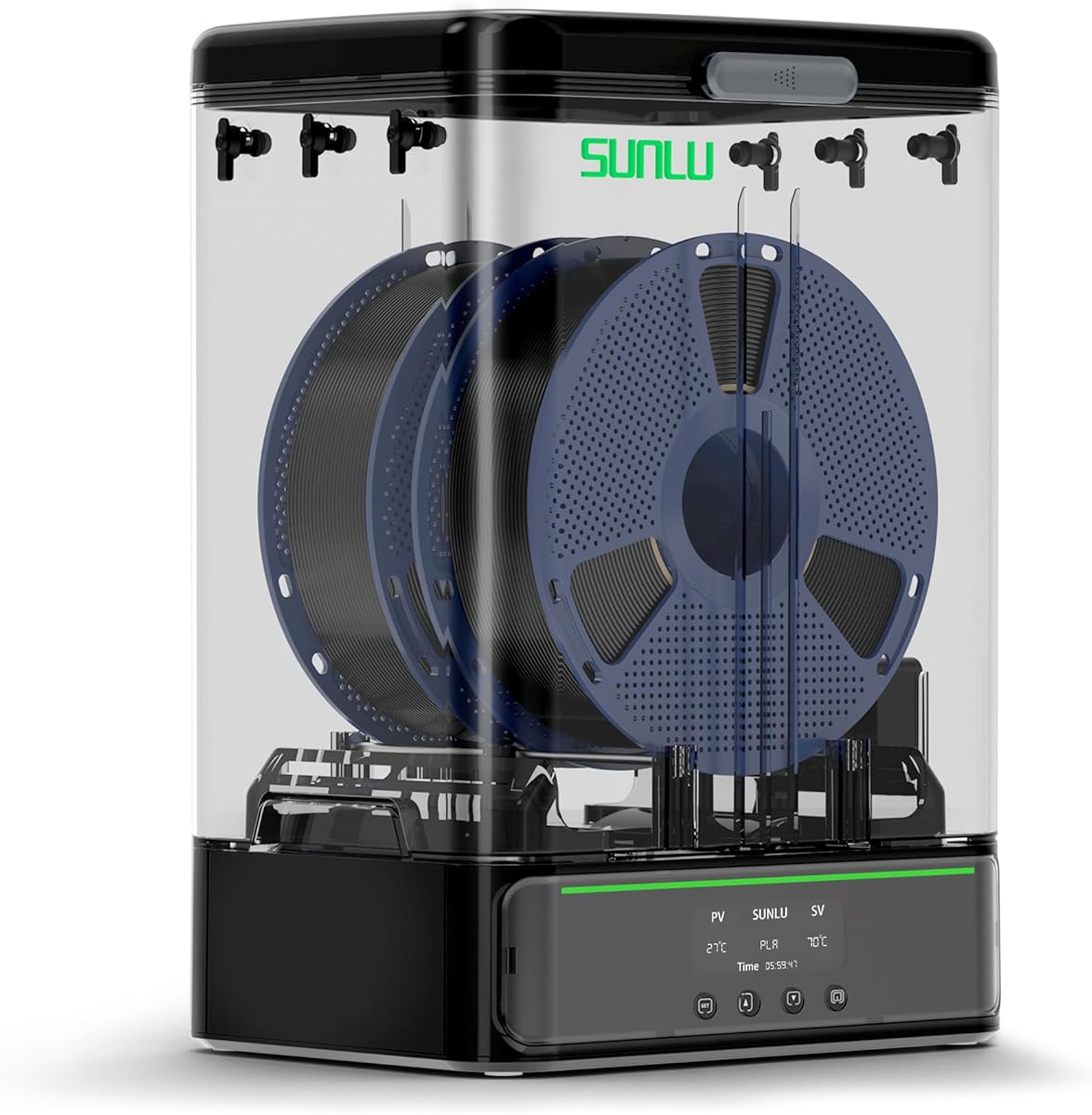
The SUNLU S1 Plus offers excellent value for casual users who need reliable drying without breaking the bank. It is incredibly quiet running at less than ten decibels which makes it suitable for home offices.
We may earn a commission when you buy through this link, at no additional cost to you.
The interface is straightforward with a large screen showing temperature and time clearly. It allows for up to ninety nine hours of drying time giving you full control over how long spools stay dry before use.
While it does not handle high-temp engineering plastics due to the lower max temperature it covers most common materials like PLA and PETG effectively. The size is compact fitting well on most desks.
Buy this if you primarily print with standard filaments and want a simple quiet solution. It solves the wet filament problem without unnecessary complexity or high cost making it a great starter box.
Produces less than ten decibels of noise ensuring your work environment stays peaceful even during overnight drying cycles near your desk.
Allows manual time settings from one to ninety nine hours so you can tailor drying duration to specific moisture levels and materials.
We may earn a commission when you buy through this link, at no additional cost to you.
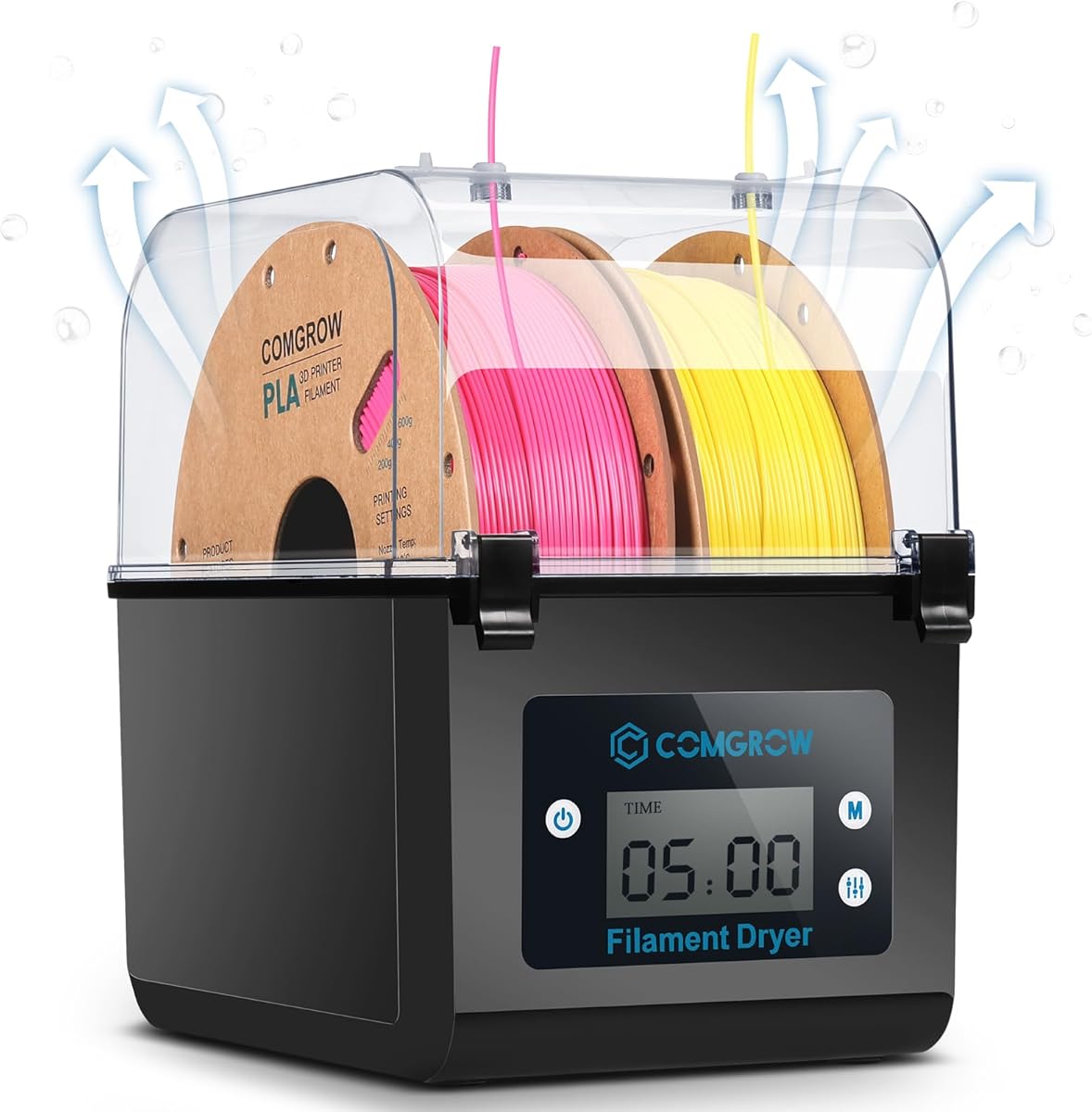
Comgrow provides a straightforward dryer box that balances features and affordability well. It can store two 1kg spools which is helpful if you print large jobs or want backup material ready.
We may earn a commission when you buy through this link, at no additional cost to you.
The design focuses on keeping filament dry during printing with a smooth Teflon outlet. The LCD screen makes it easy to monitor temperature and humidity in real time during the drying process.
It works best with standard filaments like PLA and ABS due to its lower temperature limit. Users should note that high-temperature materials may require a different dryer capable of reaching higher degrees.
This model is a practical choice for beginners or those needing a reliable backup unit. The support team is responsive and the build quality is sufficient for consistent results on common prints.
Holds two standard spools allowing you to keep backup material dry and ready without taking up extra desk space.
Clear LCD and touch buttons let you set parameters quickly without guessing or digging through complex menus.
We may earn a commission when you buy through this link, at no additional cost to you.
The Creality Space Pi SE uses a fan to circulate heat which speeds up the drying process significantly. It reaches 65 degrees Celsius within fifteen minutes ensuring you do not wait long to start printing.
We may earn a commission when you buy through this link, at no additional cost to you.
Internal insulation helps maintain temperature and prevents the exterior from getting too hot. This makes it safer to use near other equipment while still keeping the filament environment stable and dry.
Controls are simplified with a knob and screen which is easy to use once set up. The timer goes up to 24 hours which is sufficient for most standard drying needs without being excessive.
This is a smart choice if you want a balance between price and performance. It handles most common filaments well and the quick heating cycle means less idle time on your machine.
Built-in fan circulates air to heat chamber quickly so you can dry filaments faster and start printing sooner.
Insulation cotton keeps internal heat where it belongs protecting your desk and hands from burns during operation.
We may earn a commission when you buy through this link, at no additional cost to you.
This model brings a larger touch interface and more advanced controls to the table. It supports up to twelve preset filament types so you can select your material and start drying instantly.
We may earn a commission when you buy through this link, at no additional cost to you.
One standout feature is the power-off memory which retains your settings after a blackout. This means you do not lose your configuration and can resume drying immediately once power returns.
The timer allows for up to 48 hours giving flexibility for materials that need extended drying. The screen also switches between temperature units easily suiting users in different regions.
Choose this if you need preset convenience and robust controls. It is well-suited for users who switch between many filament types regularly and value a detailed interface.
Twelve preset settings let you start drying with a single tap tailored to specific common materials.
Remembers your settings during power outages so you never lose configuration or waste time resetting after interruptions.
We may earn a commission when you buy through this link, at no additional cost to you.
The black version of the SUNLU S1 Plus focuses on practical design with a fan to speed up moisture discharge. This helps reduce the impact of wet weather on your filament quality during printing.
We may earn a commission when you buy through this link, at no additional cost to you.
The LCD screen clearly shows temperature time and humidity so you can track progress easily. It supports up to 3mm spools which is helpful if you use specialty filament sizes.
The interface uses buttons on the sides which are intuitive for setting time and temperature. It is designed for home environments where simplicity and quiet operation are preferred over complex features.
This unit is great for users living in humid climates who need consistent drying. It removes excess water effectively and works well with most common printing materials available today.
Upgraded fan design speeds up moisture discharge to improve print quality especially in humid conditions.
Two inch screen displays real time data so you can monitor drying conditions without opening the box.
We may earn a commission when you buy through this link, at no additional cost to you.
The Polymaker Polydryer is a passive storage solution designed to keep moisture out without power. It uses a tight seal and desiccant packs to maintain a dry environment inside the box effectively.
We may earn a commission when you buy through this link, at no additional cost to you.
The built-in hygrometer lets you see humidity levels at a glance so you know when to change desiccants. You can feed filament directly into your printer without opening the box and exposing spools to air.
This model is best for storage between jobs rather than active drying of wet material. It is ideal for keeping dry filament dry and preventing re-absorption of moisture during pauses.
Choose this if you want a simple reliable container for shelf life extension. It requires minimal effort and helps you avoid stringing by keeping your spools sealed and dry.
Airtight seal combined with desiccant packs locks out moisture to protect filaments during long term storage.
Design allows feeding filament while sealed ensuring moisture protection even when printer pauses or moves around.
We may earn a commission when you buy through this link, at no additional cost to you.
The SUNLU SP2 is built for users who buy filament in bulk. It holds spools up to 3kg which reduces the need for frequent refills and allows longer print runs without interruption.
We may earn a commission when you buy through this link, at no additional cost to you.
Heating reaches 70 degrees in just fifteen minutes thanks to the 250W PTC element. The detachable base allows you to use it as a storage box after drying without moving the spool manually.
The HD LCD screen shows temperature humidity and time clearly. It is designed to be quiet so it does not disturb your workspace during overnight drying cycles.
This is a great choice if you rely on high-volume spools for productivity. The quick heating and storage integration make it efficient for active printing environments.
Accommodates 3kg spools and multiple rolls so you can keep large jobs running without constant intervention.
Base acts as storage after drying so you can seal filament without transferring spools to a different container.
We may earn a commission when you buy through this link, at no additional cost to you.
The Sovol SH02 is designed to dry two spools simultaneously saving space and time for multi-material prints. It uses a 150W PTC heater with a fan for uniform heat distribution inside the box.
We may earn a commission when you buy through this link, at no additional cost to you.
It includes nine preset temperatures for common filament types so you do not have to guess settings. The safety system will cut power if the temperature exceeds 130 degrees preventing damage to filament.
The sealing is improved over previous models to better protect spools when not in use. You can also add desiccant packs to enhance moisture removal during storage periods.
This box is a solid choice for those with two printers or dual extruders. It balances cost with performance and ensures both spools stay dry and ready for use.
Designed for two spools to dry simultaneously so you can serve two printers without needing separate boxes.
Automatically cuts off heating at high temperatures to protect your filament and equipment from overheating risks.
We may earn a commission when you buy through this link, at no additional cost to you.
Selecting the right dryer requires evaluating capacity, heating speed, and temperature limits to match your needs.
Consider how many spools you typically need to dry at once. Some boxes hold one spool while others hold four. Check if the box supports your spool weight whether standard 1kg or large 3kg.
Choose a capacity that fits your workflow to avoid bottlenecks when running multiple jobs.
Ensure the dryer supports the materials you use. Standard boxes cap around 50 to 60 degrees for PLA and PETG. Higher end models reach 85 degrees for ABS and engineering materials.
Always check the maximum temperature to avoid damaging sensitive filaments.
PTC heaters with fans provide more uniform drying than heating pads. Look for units with 360 degree air circulation to prevent hot spots that leave moisture in some sections.
Units with fans dry faster and more consistently.
The box must be airtight to keep moisture out when not actively drying. Look for silicone seals and robust latches to prevent humidity ingress between printing jobs.
Good sealing protects dry filament from re-absorbing moisture.
Controls should be intuitive whether they are buttons knobs or touch screens. Clear displays showing temperature humidity and time help you track progress without opening the box.
Simple interfaces reduce setup time and errors.
Timers allow you to set drying duration so the box turns off automatically. Some models offer auto humidity control which cycles based on sensor readings.
Automation saves energy and prevents over-drying.
Measure your desk space before buying. Larger boxes hold more spools but take up significant room. Ensure there is space for PTFE tubes to run to your extruder.
Balance capacity with available workspace.
Fans and heaters can generate noise. If you print in a shared living space look for units advertised as quiet or under 10dB.
Quiet operation is essential for office environments.
First load your spool into the box and thread the filament through the designated hole to the printer. Ensure the Teflon tube fits snugly to prevent air leaks at the connection point.
Set the temperature and time according to your filament type. Start the box and wait for the display to show the target temperature. Do not open the box while it is running to maintain sealing.
After drying remove the spool and store it in a sealed bag if not printing immediately. Regularly clean the interior and replace desiccant packs if your model uses passive storage features.
Not always. If you store filament in dry bags or low humidity environments fresh spools may not need drying. However old or exposed spools benefit from a few hours in a dryer to prevent print defects like stringing.
It depends on the temperature. PLA needs lower heat while ABS needs higher heat. Use different settings for each material and do not dry them in the same batch if the dryer cannot switch quickly.
Most standard filaments like PLA or PETG dry in three to six hours. More moisture sensitive materials like Nylon might need eight to twenty four hours depending on humidity levels.
Proper drying should not change color significantly. However overheating or too long in the dryer can cause discoloration. Always stay within recommended temperature limits for your specific material.
Yes that is one of the main benefits. You can feed filament directly from the dryer to the printer while it maintains a dry environment preventing moisture absorption during long jobs.
Most modern units do not remember settings so you must reset them after a power loss. Some premium models have memory features that resume your previous temperature and time settings automatically.
We recommend the Creality Space Pi X4 for high volume users and the SUNLU S1 Plus for budget conscious buyers. Both offer solid performance and reliable sealing to protect your material.
Prioritize temperature range and spool capacity to match your printing needs. A unit that is too small or cool will not solve moisture issues for all your materials.
Prices and availability fluctuate so verify the current stock before purchasing. Investing in the right dryer now saves time and waste on failed prints later.