
Vogzone for MCX4121A-ACAT
4.7Editor score
ConnectX-4 Lx controller
RoCE v1 v2 support
Low-profile bracket included
This guide compares the top 25GbE network cards for servers and workstations, evaluating performance, compatibility, and features to help you choose the right
High-speed networking is essential for modern data centers and enterprise environments. A reliable 25GbE network card ensures your infrastructure handles large data transfers efficiently without bottlenecks or latency issues.
We evaluated ten top-rated adapters based on controller quality, port flexibility, and software support. Each product offers unique strengths for virtualization, storage, or general server networking across different platforms.
Each pick highlights key specs, pros, cons, and ideal use cases to simplify your decision. Please note that availability and pricing fluctuate frequently so verify details before purchasing your adapter.
4.7Editor score

5.0Editor score

4.0Editor score
This side-by-side comparison outlines the key specifications and capabilities of each adapter to help you identify which model aligns best with your specific server or workstation requirements.




The QXG-25G2SF-E810 delivers enterprise-grade networking with dual ports and robust FEC features ensuring reliable data transfer for busy networks.
We may earn a commission when you buy through this link, at no additional cost to you.
It leverages the Intel E810 controller to provide up to 50 Gbps combined throughput via port trunking. This makes it ideal for accelerating file sharing and intensive data loads in enterprise environments.
The FEC ensures data integrity even under heavy stress while compatibility spans QNAP QTS and general Windows or Linux OS options. However it comes at a higher price than generic alternatives.
Buyers seeking a dedicated solution for QNAP NAS systems will find this card the most reliable choice for maintaining stable high-speed connectivity across their storage infrastructure.
Forward Error Correction (FEC) ensures high reliability and data integrity during intensive transfer operations in enterprise networks.
Combining both ports allows achieving up to 50 Gbps total transfer speeds for faster file sharing and data access.
We may earn a commission when you buy through this link, at no additional cost to you.
The Synology E25G30-F2 is purpose-built for Synology systems providing seamless high-performance storage applications and reliable network failover capabilities.
We may earn a commission when you buy through this link, at no additional cost to you.
It enables higher simultaneous throughput through port failover and load balancing features ensuring continuous operations even if one link fails. This redundancy is critical for business continuity.
However compatibility is strictly limited to Synology hardware and DSM 7.1.1 or newer. The 5-year warranty adds peace of mind for users invested in the Synology ecosystem.
If you run a Synology NAS this adapter offers the best integration and reliability while other platforms should consider more versatile options.
Two 25GbE ports support demanding storage applications with higher simultaneous throughput for faster data access speeds.
Built-in port failover and load balancing features ensure network resilience and continuous availability of shared storage.
We may earn a commission when you buy through this link, at no additional cost to you.
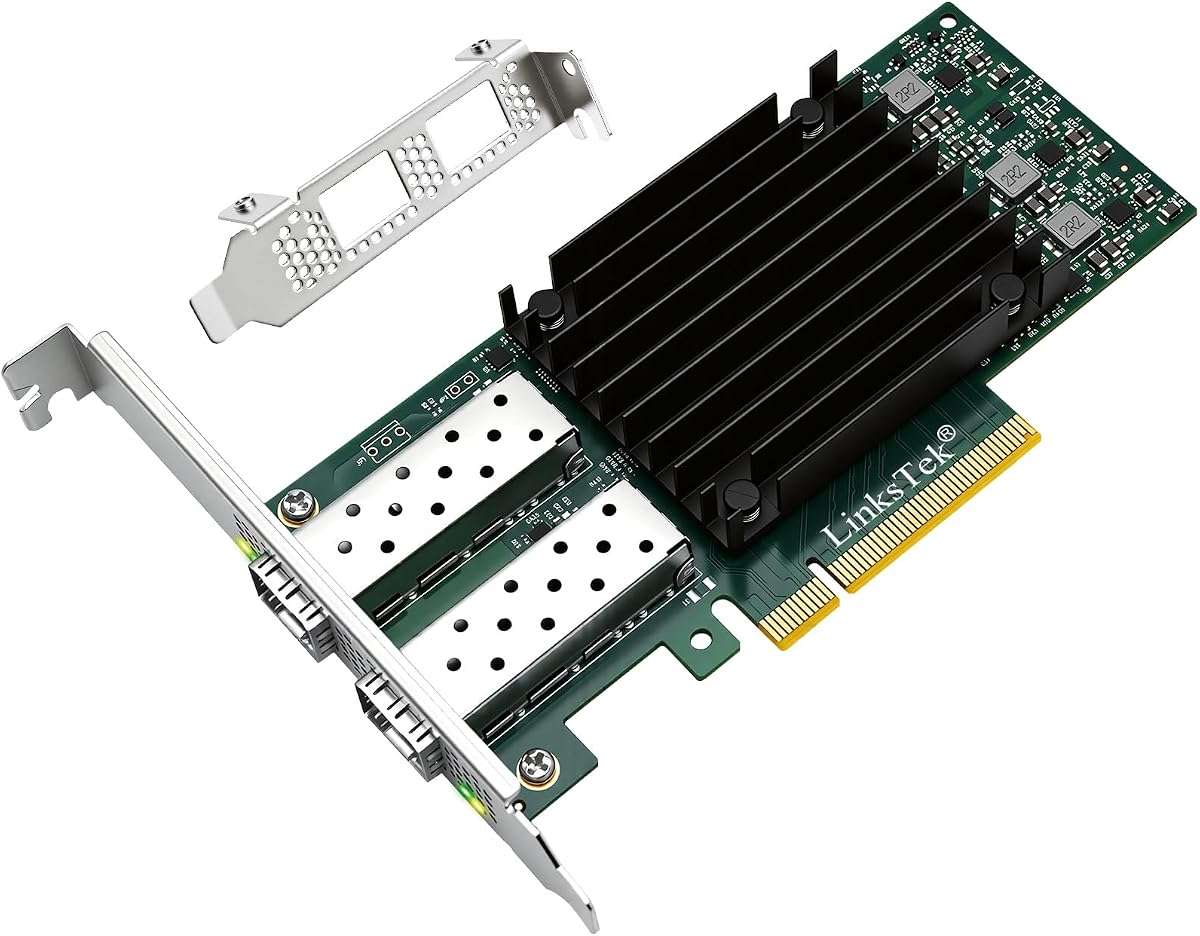
The Vogzone MCX4121A-ACAT provides a budget-friendly path to dual 25GbE connectivity using the proven Mellanox ConnectX-4 Lx controller for reliable virtualization.
We may earn a commission when you buy through this link, at no additional cost to you.
It delivers unmatched scalability and efficiency with features like SR-IOV and RoCE v1 v2 support enabling high bandwidth and low latency for big data applications.
While third-party quality varies the included low-profile bracket and wide OS support make it a compelling option for budget-conscious buyers needing advanced networking features.
Buyers looking for maximum performance per dollar should consider this adapter while verifying driver compatibility with their specific OS distribution before purchase.
True hardware-based I/O isolation and unmatched scalability ensure efficient performance for cloud and data analytics workloads.
SR-IOV technology enables efficient management of I/O resources across multiple virtual machines for optimized server performance.
We may earn a commission when you buy through this link, at no additional cost to you.
The 10Gtek 25G Ethernet Network Card brings next-gen PCIe 4.0 performance to dual SFP28 ports ensuring future-proof bandwidth for demanding server workloads.
We may earn a commission when you buy through this link, at no additional cost to you.
It features the Intel E810 controller enabling robust support for RDMA and PXE across a wide range of Windows and Linux systems including ESXi.
While it lacks Mac support the inclusion of giant frame up to 9.5KB and broad OS compatibility make it a strong value for server virtualization.
Users prioritizing future bandwidth headroom should select this model while ensuring their switch supports the required PCIe 4.0 lanes for optimal operation.
PCIe 4.0 x8 interface provides 16 GT/s per lane ensuring the bandwidth needed for simultaneous 25GbE ports.
Support for Windows Linux and VMware ESXi with RDMA and PXE makes this card ideal for virtualized server environments.
We may earn a commission when you buy through this link, at no additional cost to you.
The CX4121A delivers a cost-effective RDMA solution for virtualization and storage servers leveraging the proven ConnectX-4 Lx EN controller.
We may earn a commission when you buy through this link, at no additional cost to you.
It offers IEEE 802.3by compliance with support for VXLAN and GENEVE overlay networks ensuring seamless integration into modern data center architectures.
Broad OS support including Windows Linux and FreeBSD combined with giant frame capability makes this card versatile for diverse workload requirements.
Virtualization and storage admins needing RDMA without high costs will find this adapter a reliable flexible choice for high-performance computing.
Supports RDMA over RoCE for low latency and high throughput in big data and storage applications.
Supports NVGRE VXLAN and GENEVE overlay networks to enable flexible network segmentation and security.
We may earn a commission when you buy through this link, at no additional cost to you.
The Intel® XXV710-DA2 is an official enterprise-grade adapter offering advanced application offloads for maximum performance and efficiency.
We may earn a commission when you buy through this link, at no additional cost to you.
It includes Dynamic Device Personalization (DDP) and DPDK optimization to increase packet processing efficiency for NFV and cloud deployments.
Small packet performance is excellent making it ideal for network appliances and virtualized servers requiring high throughput and low latency.
Organizations requiring proven Intel hardware and advanced offload capabilities should prioritize this adapter for critical infrastructure deployments.
DPDK optimization and excellent small packet performance ensure maximum efficiency for network functions virtualization.
Intel Flow Director enables hardware-based application traffic steering to optimize network resource allocation.
We may earn a commission when you buy through this link, at no additional cost to you.
The GLOTRENDS ST7400 meets modern server requirements with an OCP 3.0 interface delivering stable throughput and integrated traffic management.
We may earn a commission when you buy through this link, at no additional cost to you.
Original Intel E810-XXVAM2 controller ensures reliable performance with on-chip QoS traffic management and SR-IOV for cloud and virtualization workloads.
Support for RDMA and PXE alongside broad OS compatibility makes it suitable for NAS and server environments needing high bandwidth.
Server administrators deploying OCP 3.0 racks should consider this card for its balance of performance and flexibility.
OCP 3.0 ready design ensures seamless integration into modern server and NAS deployments.
On-chip QoS and traffic management features ensure smooth data flow across virtualized workloads.
We may earn a commission when you buy through this link, at no additional cost to you.
The Sonnet Twin25G T5 brings dual 25GbE networking to Thunderbolt laptops offering an ideal solution for media production and post-production workflows.
We may earn a commission when you buy through this link, at no additional cost to you.
It includes SFP28 transceivers and Thunderbolt 5 cable enabling immediate deployment on compatible fiber infrastructure without extra purchases.
With full 25GbE performance and power delivery it serves as a versatile hub for high-performance networking on mobile workstations.
Creative professionals needing high-speed external networking should invest in this Thunderbolt adapter for seamless file sharing and collaboration.
Includes two SFP28 optical transceivers to enable immediate deployment on compatible fiber infrastructure.
Delivers full 25GbE performance over Thunderbolt 5 ensuring consistent speeds for media and AI workflows.
We may earn a commission when you buy through this link, at no additional cost to you.
The Sonnet Twin25G PCIe adds dual optical 25GbE connections to any computer with PCIe slots offering broad cross-platform compatibility.
We may earn a commission when you buy through this link, at no additional cost to you.
It includes SFP28 transceivers and supports backward compatibility with 10GbE allowing seamless integration with existing switches.
Mac and Linux users benefit from this solution though macOS 15.3.1 or 15.4 currently face compatibility issues pending updates.
Those needing optical connectivity across Mac Windows and Linux should choose this card while noting the specific OS caveats.
Mac Windows and Linux compatibility make this adapter versatile for mixed OS environments.
Backward compatibility with 10GbE allows seamless integration with existing infrastructure.
We may earn a commission when you buy through this link, at no additional cost to you.
The Mellanox MCX512A-ACAT ConnectX-5 EN is an intelligent RDMA-enabled adapter providing advanced application offloads for cloud and telco platforms.
We may earn a commission when you buy through this link, at no additional cost to you.
It delivers dual 25GbE performance via SFP28 with support for Web 2.0 and storage workloads ensuring robust connectivity.
While ConnectX-5 is older it still offers reliable performance for those needing RDMA and application offloads without latest-gen cost.
Adapters prioritizing established connectivity and cost-effective RDMA should consider this option for their server upgrades.
Advanced application offload capabilities ensure efficient performance for cloud storage and telco workloads.
RDMA enabled connectivity reduces CPU overhead and improves latency for high-performance computing.
We may earn a commission when you buy through this link, at no additional cost to you.
Selecting the right 25GbE network card requires evaluating controller quality, interface compatibility, OS support, and specific workload needs to ensure optimal performance.
The controller chip determines raw performance, latency, and available offloads. Intel E810 and Mellanox ConnectX series offer robust capabilities for enterprise and virtualization.
Look for controllers that match your server generation and offer features like RDMA or packet offloads for efficiency.
Ensure the card supports PCIe 3.0 or 4.0 x8 slots for maximum bandwidth. Older slots may bottleneck performance or lack sufficient power.
Check your motherboard manual for slot widths and power limits before purchasing to guarantee a physical fit.
Cards use SFP28 ports supporting DAC cables optics or AOCs. Choose optics for long distances or DAC for short cost-effective links.
Confirm your network switches support SFP28 and the required speed to avoid mismatched links.
Verify the vendor provides stable drivers for your OS. Linux distributions Windows Server and VMware ESXi have different driver requirements.
Third-party cards may have limited OS support so check documentation before installing on critical systems.
If using virtual machines look for SR-IOV and VMDq support to offload I/O efficiently across multiple VMs.
This feature is essential for maximizing server utilization without CPU bottlenecks.
OEM cards typically offer longer warranties and better support channels compared to third-party options.
Check warranty terms and customer feedback to ensure long-term reliability for your infrastructure.
Low-profile brackets fit small chassis while tall brackets suit standard servers. Verify your case clearance to avoid installation issues.
Some cards include both brackets allowing flexibility across different hardware setups.
Consider offloads like DPDK, VXLAN, or PTP for specialized networking needs in NFV or time-sensitive applications.
These features can significantly reduce CPU load but may require specific configuration or compatible switches.
Before installation ensure your server is powered down and unplugged to prevent static damage. Ground yourself and handle the card by edges to protect components.
Install the card firmly into the PCIe slot and secure the bracket with screws. Connect compatible SFP28 cables or optics ensuring proper insertion and locking.
After boot install drivers provided by the vendor or use OS-native drivers. Configure link speed and verify connectivity through system network settings.
Yes most modern 25GbE cards support auto-negotiation to 10GbE allowing them to work with existing 10GbE switches. Always verify your switch model supports auto-negotiation to avoid link issues.
Yes SFP28 cards support Direct Attach Copper (DAC) cables for short distances typically under 5 meters. Ensure the DAC cable matches the switch port and NIC requirements for stable operation.
Linux typically offers the most extensive support for RDMA over Ethernet including RoCE and iWARP. Windows Server supports RDMA but may require specific driver versions for full feature parity.
To achieve full 25GbE performance both the NIC and the connected switch must support 25GbE. If using a 10GbE switch the link will negotiate down to 10Gbps.
Third-party cards can offer excellent value but may lack long-term driver support compared to OEMs. Always check compatibility lists and reviews before deploying critical infrastructure.
Low-profile brackets suit small form factor or tower cases while tall brackets fit standard server chassis. Many cards ship with both so verify case clearance before installation.
We have reviewed ten top 25GbE network cards highlighting strengths from budget Mellanox clones to premium Thunderbolt and enterprise Intel adapters.
Prioritize controller quality and OS support to ensure stable performance across your virtualized or physical server workloads.
Always confirm current availability and pricing before purchase as these products fluctuate based on market demand and technology shifts.