
ADS1115 16 Bit I2C Module
5.0Editor score
16 Bit Resolution
4 Channel Inputs
I2C Interface
This guide compares the top 10 Arduino ADC boards for precision sensing, data acquisition, and IoT projects based on resolution speed and compatibility.
Arduino boards lack built-in analog inputs beyond basic pins. An external ADC board expands capabilities for sensors requiring high precision. Choosing the right module ensures accurate voltage readings across diverse applications.
We evaluated ten top-rated analog-to-digital converter boards for Arduino compatibility. Criteria included resolution, sample rate, interface type, and programmable gain features. Each selection balances performance with ease of integration for makers.
Every pick highlights key specifications and real-world use cases for your project. Prices and availability fluctuate frequently on major marketplaces. Always verify current listings before purchasing to ensure the best deal today.
5.0Editor score

4.6Editor score

4.4Editor score
The following table presents a side-by-side comparison of all ten selected ADC boards. Review resolution bit depth, channel count, data rates, and voltage compatibility to find the ideal match for your sensing needs.


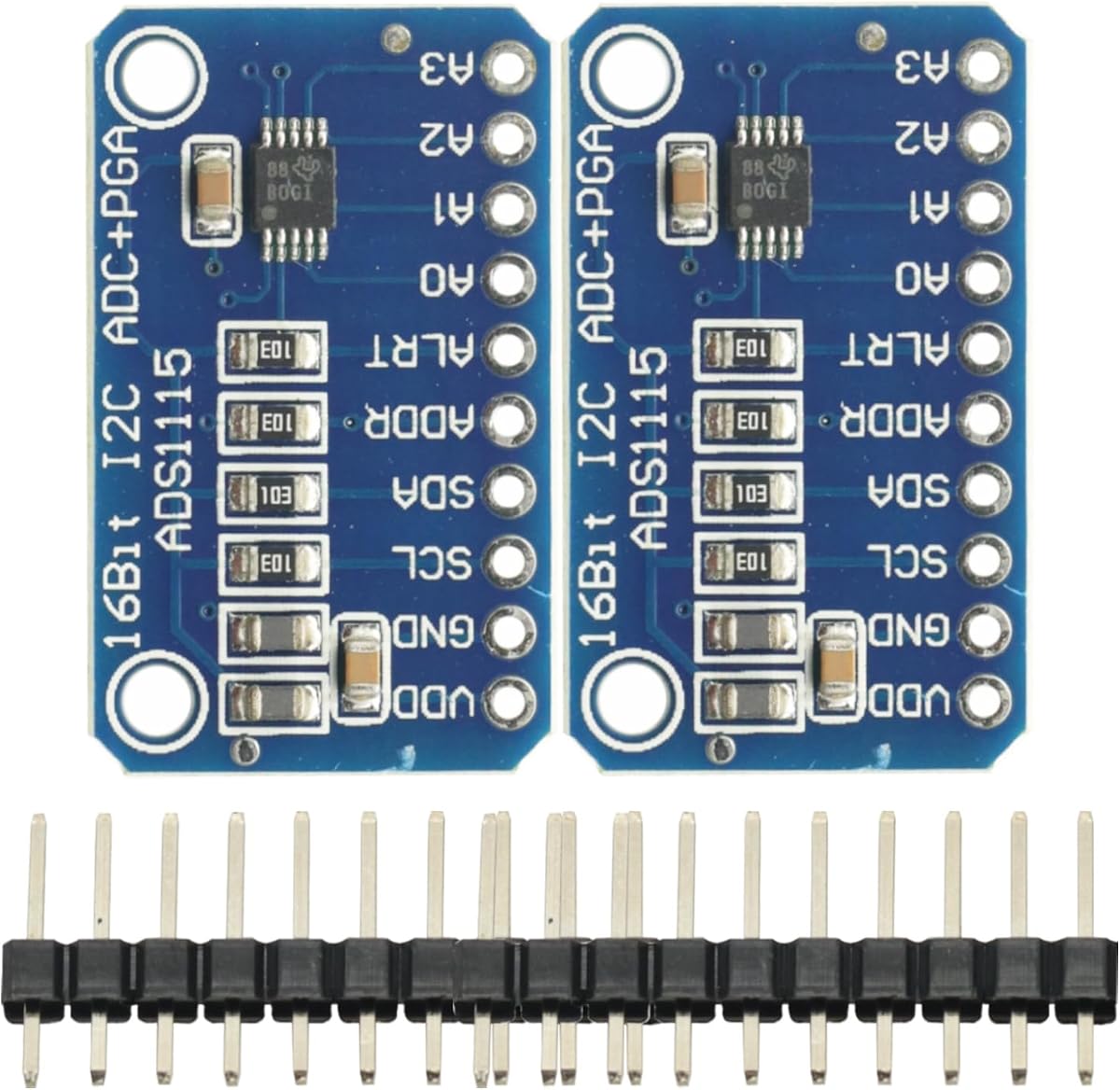


This pack of three ADS1115 modules offers exceptional value for beginners needing multiple ADC channels. It earns high praise for reliable 16-bit conversion and ease of integration with I2C.
We may earn a commission when you buy through this link, at no additional cost to you.
The onboard programmable gain amplifier allows you to adjust input ranges from ±0.256V to ±6.144V. This flexibility is crucial when measuring low-voltage sensors like thermocouples or strain gauges accurately.
While the data rate tops out at 860 samples per second, it is sufficient for most temperature and voltage monitoring tasks. The auto shut-down feature in single-shot mode helps conserve power in battery projects.
This bundle is perfect for classroom labs or multi-project setups. If you need several ADCs without breaking the budget, this selection delivers consistent performance across all three modules.
Seven programmable ranges let you optimize resolution for different sensor outputs. Whether measuring millivolts or volts, you can tune the PGA to maximize accuracy.
The standard I2C protocol simplifies wiring with only two data pins. You can address up to four units on one bus for a total of sixteen channels.
We may earn a commission when you buy through this link, at no additional cost to you.
When you need extreme accuracy, the ADS1256 stands out with its 24-bit resolution. It captures minute voltage changes that standard 10-bit or 12-bit microcontroller ADCs miss completely.
We may earn a commission when you buy through this link, at no additional cost to you.
This board features an on-board 2.5V datum voltage source, ensuring stable readings even if supply voltage fluctuates. The low nonlinearity error of ±0.0010% makes it ideal for laboratory-grade measurements.
It supports up to 30ksps data rates and can be configured for eight single-ended inputs or four differential pairs. This versatility suits complex signal conditioning tasks without extra components.
Choose this module for professional data acquisition or sensor research. The higher complexity of SPI wiring is worth the trade-off for superior signal fidelity and reliability.
The integrated voltage reference maintains accuracy over temperature and time. You avoid adding external precision references, reducing circuit complexity and cost.
Switch between single-ended and differential modes easily via software. This allows monitoring ground-referenced signals or noise-cancelling differential signals.
We may earn a commission when you buy through this link, at no additional cost to you.
This pack focuses on build quality and long-term durability. The ENIG gold plating ensures excellent solderability and resistance to oxidation, making it a premium choice for critical projects.
We may earn a commission when you buy through this link, at no additional cost to you.
Designed with makers in mind, it works seamlessly with both 3.3V and 5V logic levels without needing level shifters. This compatibility simplifies wiring when using ESP32 or Uno boards.
Each module comes with pre-soldered headers ready for breadboarding. The comprehensive library support for C++ and CircuitPython speeds up development for students and professionals alike.
If you value component longevity and ease of use, this set is worth the investment. It is specifically suited for classroom labs, IoT nodes, and multi-sensor monitoring systems.
Gold plating prevents corrosion in humid environments. Your connections stay reliable even after long periods of storage or use.
Compatible with popular boards like Raspberry Pi, ESP32, and STM32. Extensive documentation helps you get started quickly with minimal friction.
We may earn a commission when you buy through this link, at no additional cost to you.
With a perfect rating, this module proves its reliability in practical applications. It offers the standard ADS1115 features in a compact package suitable for space-constrained projects.
We may earn a commission when you buy through this link, at no additional cost to you.
The seven programmable input ranges give you fine control over measurement sensitivity. You can switch between 0.256V and 6.144V ranges depending on the signal strength you expect.
Although the board finish is standard, the electrical performance remains consistent. It handles noisy environments well due to internal filtering and stable voltage references.
This is a great choice for hobbyists who want two units for redundancy. It balances cost and quality effectively for general-purpose analog data collection.
Choose sample rates between 8 and 860 SPS to match your needs. Lower rates save power while higher rates capture faster signal changes.
Input channels support up to VDD without damage. Built-in protection circuits help prevent accidental voltage spikes from harming the chip.
We may earn a commission when you buy through this link, at no additional cost to you.
HiLetgo is a well-known brand in maker communities, and this pack reflects their standard quality. It includes three identical modules, perfect for large scale projects needing multiple sensors.
We may earn a commission when you buy through this link, at no additional cost to you.
A standout feature is the comparator mode, which is helpful for threshold detection tasks. You can set high and low limits to trigger interrupts without continuous polling by the MCU.
The wide voltage supply range ensures stable operation across different power sources. Whether you power it from a USB port or a battery regulator, it adapts well.
This set offers a reliable foundation for distributed monitoring networks. If you need to spread sensors across different locations, having three modules ready to go simplifies installation.
Use this mode to monitor alarms or safety limits. It reduces CPU load by waking up the processor only when limits are crossed.
Single-shot mode allows automatic power saving after conversion. This extends battery life in portable wireless sensor nodes.
We may earn a commission when you buy through this link, at no additional cost to you.
This bulk pack is designed for users needing four units immediately. It is cost-effective for classroom kits or manufacturing prototypes where quantity matters more than individual premium finish.
We may earn a commission when you buy through this link, at no additional cost to you.
Each board includes the full ADS1115 feature set with programmable gain amplifiers. You can sample four differential signals simultaneously, which is useful for multi-phase electrical measurements.
Internal oscillators ensure stable timing without external crystals. This simplifies wiring and reduces component count for embedded systems that prioritize space and power efficiency.
Consider this option when you are setting up a large sensor array. While individual reliability might vary, the sheer number of units allows you to swap out any faulty ones easily.
Capture multiple differential signals at once with precision. This minimizes timing skew between readings in dynamic environments.
All units use the same standard chip architecture. Documentation and libraries apply equally to every board in the pack.
We may earn a commission when you buy through this link, at no additional cost to you.
Another highly rated dual pack, this option delivers consistent performance for general sensing tasks. It fits well in standard projects without requiring extra logic level converters.
We may earn a commission when you buy through this link, at no additional cost to you.
The ability to configure either four single-ended or two differential inputs gives you flexibility. This is useful when your sensor types change from one project to the next.
Input ranges can be programmed to match specific voltage levels closely. This maximizes the useful resolution of the 16-bit converter for your specific signal amplitude.
This pair is ideal for home automation or basic industrial monitoring. The combination of high rating and affordability makes it a safe choice for beginners.
Switch modes easily to fit your hardware needs. You are not locked into a fixed wiring scheme for your sensors.
Runs on 2.0V to 5.5V supplies safely. This matches almost every microcontroller voltage rail available today.
We may earn a commission when you buy through this link, at no additional cost to you.
This board targets advanced applications requiring simultaneous sampling across eight channels. It stands out with a 200kHz sampling rate, useful for audio or vibration analysis.
We may earn a commission when you buy through this link, at no additional cost to you.
The input range of ±5V or ±10V allows direct connection to line-level signals without extra attenuation. High input impedance prevents signal loading on delicate circuits.
Oversampling modes help improve signal-to-noise ratio in noisy environments. However, the complexity of the SPI protocol and wiring may challenge casual users.
Choose this for specialized industrial monitoring or research projects. The lower ratings often reflect the learning curve rather than the chip itself which is robust.
All eight channels sample at the exact same time. This prevents phase errors when analyzing multi-phase AC systems.
Select between serial or parallel data output modes. Serial saves pins while parallel speeds up data throughput.
We may earn a commission when you buy through this link, at no additional cost to you.
This bundle provides a reliable set of four modules for extensive sensor networks. It is particularly good for temperature and pressure data acquisition projects needing multiple points.
We may earn a commission when you buy through this link, at no additional cost to you.
The built-in PGA improves sensitivity for low-voltage signals. You can measure small changes accurately without needing an external op-amp circuit.
Compatibility with popular platforms like ESP32 and STM32 makes it versatile. This ensures your project can evolve to different controllers without changing hardware.
For general-purpose IoT development, this package offers excellent utility. The combination of quantity and performance makes it a practical choice for prototyping.
Uses only two communication pins for data transfer. This saves GPIO pins on your microcontroller for other tasks.
Delivers stable readings even with minor voltage fluctuations. Your logging systems will show cleaner data over time.
We may earn a commission when you buy through this link, at no additional cost to you.
A standard single unit from HiLetgo, this module offers a cost-effective entry point into precision ADCs. It mirrors the core capabilities of more expensive boards for simple needs.
We may earn a commission when you buy through this link, at no additional cost to you.
Operating as a comparator mode can help maintain accuracy in trigger-based events. This reduces the need for constant monitoring by your main microcontroller processor.
With a supply range of 2.0V to 5.5V, it integrates easily with battery systems. The auto shut-down feature ensures you do not drain power when not actively sampling.
Choose this for single-sensor experiments or cost-sensitive builds. It is a reliable workhorse for hobbyists who need just one conversion channel without extra complexity.
Designed to minimize energy drain during idle times. Perfect for solar-powered or long-term field deployments.
Use built-in comparators for hardware-level threshold detection. It adds safety logic to your analog input processing.
We may earn a commission when you buy through this link, at no additional cost to you.
Selecting the right ADC board requires balancing resolution, speed, and interface needs. These factors determine how well your board handles specific sensor requirements.
Resolution defines the smallest voltage change your board can detect. Higher bit counts like 24-bit are essential for thermocouples or load cells where millivolt changes matter. 16-bit boards offer a great middle ground for most general sensors like temperature or pressure. Always match resolution to your signal range to avoid wasted digital bits.
Prioritize higher resolution when measuring very small analog signals. For standard voltages up to 5V, 16-bit provides sufficient granularity.
Data rate or samples per second (SPS) dictates how fast you can read data. Most 16-bit modules cap at 860 SPS which is fine for environmental monitoring. If you need to track vibrations or audio frequencies, look for boards supporting higher rates like 30ksps or above. Faster rates ensure you capture rapid changes without missing details.
Check your sensor output frequency before buying. A slow ADC will distort fast-changing signals regardless of its resolution.
Channels define how many analog inputs you can connect simultaneously. Standard modules offer 4 inputs which works for basic projects. Multi-channel boards with 8 inputs save space when monitoring many sensors. Ensure the channels support differential inputs if you need to reject noise from long wires.
Count your sensors and add a buffer. Buying a board with extra channels prevents the need for additional hardware later.
Most boards use I2C or SPI for communication. I2C requires fewer pins and is simpler to wire, making it ideal for Arduino Uno or Nano. SPI offers faster data transfer but uses more GPIO pins. Ensure your chosen microcontroller has enough free pins for your selected interface protocol.
Use I2C for compact projects needing few wires. Opt for SPI if you need high-speed data logging.
Input range determines what voltages your ADC can handle safely. Some boards support up to 6V or even ±10V for industrial signals. Verify the max input does not exceed your supply rails to avoid damage. Adjustable ranges via programmable gain help match specific sensor outputs accurately.
Select a board that covers your sensor output span. Overvoltage can permanently damage the ADC chip.
Power consumption affects battery life in portable devices. Look for modes like single-shot or auto shut-down to save energy when sampling is not continuous. Voltage supply compatibility should match your project power source whether 3.3V or 5V. Efficient power management extends operational time in remote sensors.
Choose boards with low current draw for long-term deployments. Sleep modes are valuable for energy harvesting applications.
Construction quality impacts reliability over time. Look for RoHS compliance and gold-plated contacts for better connection stability. Pre-soldered headers save assembly time and ensure proper spacing. High-quality PCBs resist corrosion and physical stress in harsh environments.
Invest in better build materials for critical applications. This reduces maintenance costs and downtime.
Availability of libraries simplifies integration with your microcontroller. Good documentation explains register configurations and timing. Community support helps troubleshoot specific errors quickly. Without proper software tools, hardware capabilities may remain underutilized.
Check library availability for your platform before buying. Easy setup accelerates your development process.
Connect the VCC and GND pins to your microcontroller power rails first. Ensure your supply matches the board's requirements to prevent damage. Secure all ground connections to avoid noise interference in measurements.
Use pull-up resistors if required by your I2C bus logic level. Install a library for your ADC chip to handle communication and scaling. Test basic readings using the provided examples before integrating custom code.
Store unused boards in anti-static bags to protect delicate pins. Inspect headers regularly for oxidation or bending during storage. Keep firmware libraries updated to maintain compatibility with newer environments.
Arduino boards have limited internal ADC channels and resolution. An external board provides more inputs and higher precision for accurate sensing. It allows you to measure signals that exceed the microcontroller's native voltage limits.
A PGA adjusts the input signal strength before conversion. This increases resolution for low-voltage sensors by amplifying weak signals. It ensures you utilize the full digital range without wasting bits on small inputs.
Yes, many boards support addressable I2C pins to share a bus. You can chain up to four modules on a single pair of wires. This expands your channel count without adding complex wiring.
Many modern ADC boards are tolerant of both 3.3V and 5V logic. Check the specifications to confirm if level shifting is needed. Direct connection simplifies the build and reduces component count.
Use a voltage divider circuit to reduce high voltages to safe levels. Ensure the divider ratio keeps the signal within the ADC input range. Some boards also have differential modes to handle larger spans safely.
Temperature changes slowly so rates below 10 SPS are usually enough. Higher rates like 860 SPS work well for vibration or audio signals. Match the rate to the physical dynamics of the phenomenon you monitor.
We explored ten top-rated boards ranging from budget options to high-precision models. Each selection offers unique strengths whether you need speed, resolution, or multiple channels. The ADS1115 and ADS1256 remain the most popular choices for general use.
Prioritize resolution and interface compatibility based on your specific sensors. Budget packs work well for beginners but premium boards offer better reliability for critical data. Always verify power requirements to ensure long-term stability.
Prices and stock fluctuate often on online marketplaces so check current listings. Buying in bulk can save money for projects needing many channels. With these guides you can select the perfect ADC for your next project.