
HiLetgo 5pcs DHT11 Module
4.5Editor score
Simple single-wire digital output
Includes five modules and cables
Ideal for basic humidity projects
This comprehensive guide compares the top 10 Arduino temperature sensors for 2026, evaluating accuracy, range, and ease of integration for your next project.
Choosing the right Arduino temperature sensor is crucial for any electronics project involving climate control or monitoring. A good sensor provides accurate readings, reliable communication, and durability across various environmental conditions.
We evaluated ten leading options based on specifications, user feedback, and compatibility with popular microcontrollers. This list covers digital and analog types, ranging from basic modules to high-precision waterproof probes.
Each pick highlights key strengths and ideal use cases to help you match the sensor to your specific needs. Please note that product availability and pricing may fluctuate over time on retail platforms.
4.5Editor score

4.9Editor score

4.7Editor score
The following table provides a side-by-side comparison of all ten selected sensors, highlighting their key specifications and unique features to aid your selection process.




This 5-pack of DHT11 modules offers an affordable entry point for beginners needing temperature and humidity data. It features a digital output with a single-wire interface that simplifies wiring to Arduino boards.
We may earn a commission when you buy through this link, at no additional cost to you.
The module includes a bypass capacitor and pull-up resistor, reducing external component needs. Its communication protocol is straightforward, requiring minimal programming effort to integrate into hobbyist projects.
While the temperature range is limited to zero to fifty degrees, this covers most indoor environments adequately. The lower cost makes it ideal for experiments where extreme precision is not critical.
Buy this if you need multiple sensors for a classroom or DIY kit without spending much. It balances ease of use and price effectively for standard monitoring tasks.
The single-wire wiring scheme and simple protocol reduce the complexity of connecting sensors to microcontrollers.
Receiving five interchangeable modules allows for multiple simultaneous measurements across different locations.
We may earn a commission when you buy through this link, at no additional cost to you.
The AHT30 module delivers high-precision temperature and humidity readings using an I2C communication protocol. It supports simultaneous access to multiple devices, making it versatile for complex monitoring systems.
We may earn a commission when you buy through this link, at no additional cost to you.
With an accuracy of plus or minus zero point three degrees, this sensor outperforms basic models like the DHT11. The low power consumption and simple circuit design make it easy to adapt to various power sources.
The trade-off involves needing I2C lines which are slightly more complex than single-wire connections. However, the speed and accuracy gains justify this for projects requiring reliable data logging.
Choose this for projects where precision matters more than cost. It is suitable for weather stations or environmental monitoring where small temperature differences are significant.
The high accuracy ensures that subtle changes in temperature and humidity are captured reliably.
Operating between 2.0 and 5.5 volts allows compatibility with both 3.3V and 5V boards.
We may earn a commission when you buy through this link, at no additional cost to you.
The SHT31-D module provides exceptional accuracy and a wide operating range suitable for professional applications. It communicates via I2C and covers temperatures from minus forty to one hundred twenty five degrees.
We may earn a commission when you buy through this link, at no additional cost to you.
Humidity measurement is accurate to plus or minus two percent, while temperature accuracy remains tight at zero point three degrees. This precision is valuable for industrial controls or scientific experiments.
The cost is higher than basic sensors, but the reliability and range justify it for demanding tasks. It ensures consistent readings even in harsher environments where cheap sensors might fail.
Invest in this if you need reliable long-term stability. It is an excellent choice for greenhouses, HVAC systems, or any setup requiring precise climate control.
The sensor maintains stability over long periods, reducing the need for frequent recalibration.
Its wide temperature range allows use in both cold storage and high-heat industrial settings.
We may earn a commission when you buy through this link, at no additional cost to you.
This DS18B20 set includes waterproof probes suitable for submerged or damp environments like fish tanks. The adapter module simplifies connection to Arduino by housing necessary resistors on a board.
We may earn a commission when you buy through this link, at no additional cost to you.
The temperature range spans from minus fifty-five to one hundred twenty-five degrees, allowing versatile usage in freezers or warm industrial systems. The one-meter lead provides flexibility in sensor placement away from the controller.
Note that the lead itself can only withstand heat up to eighty-five degrees, limiting direct contact with very hot surfaces. For most general monitoring, this is an acceptable trade-off for waterproofing.
Buy this for liquid monitoring or outdoor weather stations where moisture resistance is essential. The included adapter reduces wiring errors for beginners.
The waterproof probe design ensures accurate readings even when fully submerged in liquids.
The adapter module integrates the pull-up resistor, streamlining the connection process.
We may earn a commission when you buy through this link, at no additional cost to you.
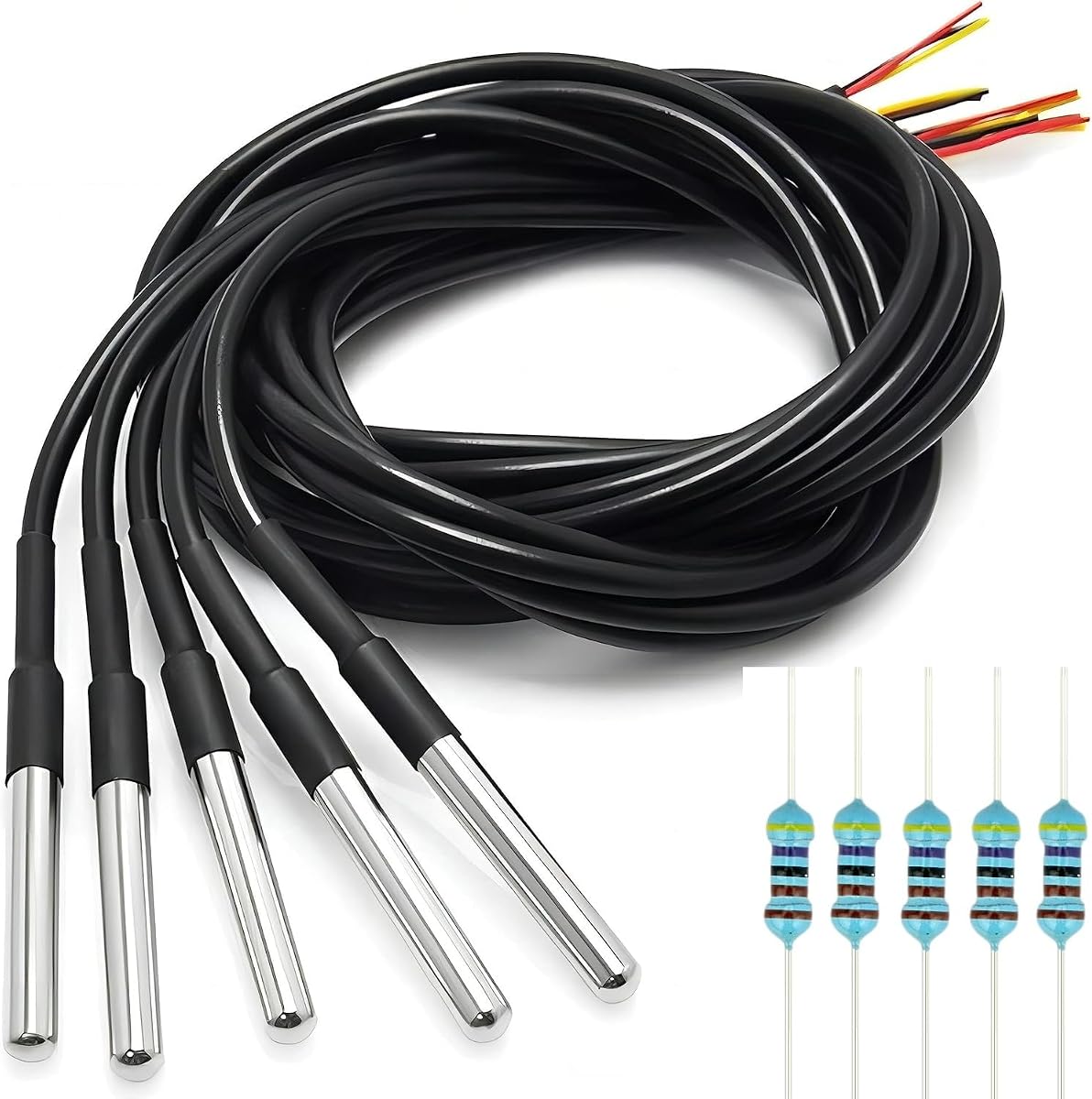
This five-piece kit offers high accuracy and waterproof capabilities for underwater or moist environments. Each probe is designed to operate safely in wet conditions without damage from water or moisture.
We may earn a commission when you buy through this link, at no additional cost to you.
The inclusion of five resistors ensures you have all necessary components for the 1-Wire interface. It supports a wide voltage range from three to five point two five volts for flexible power options.
While the packaging is functional, the main benefit lies in having multiple sensors ready for deployment. This is perfect for distributed temperature networks across a large area.
Select this for large-scale DIY projects needing multiple sensors without individual buying. The cost-efficiency is hard to beat for hobbyists and educators.
Having resistors included means you do not need to source extra parts before starting.
It works seamlessly with Arduino, Raspberry Pi, ESP32, and STM platforms for flexibility.
We may earn a commission when you buy through this link, at no additional cost to you.
This basic module uses digital signal output to provide combined temperature and humidity readings reliably. It is constructed with a dedicated digital module for high reliability and long-term stability.
We may earn a commission when you buy through this link, at no additional cost to you.
The single-wire scheme simplifies wiring significantly, while the protocol reduces programming overhead. Humidity error is within five percent, which is acceptable for general home monitoring tasks.
Its range of zero to fifty degrees covers standard indoor climates well. However, it is not suitable for extreme cold or high-heat industrial environments.
Use this for simple learning projects or climate alerts. It is an economical choice for tracking daily fluctuations in a living space.
The dedicated digital modules ensure consistent performance over extended periods of use.
The simple communication protocol allows you to write code quickly without complex libraries.
We may earn a commission when you buy through this link, at no additional cost to you.
This kit includes stainless steel probes encased in waterproof housing for harsh wet conditions. The adapter boards feature integrated pull-up resistors to enable direct GPIO connection without extra components.
We may earn a commission when you buy through this link, at no additional cost to you.
It delivers precise readings from minus fifty-five to one hundred twenty-five degrees with tight accuracy. The set includes jumper wires and resistors, making it a truly ready-to-use solution.
While it provides fewer probes than some packs, the included accessories save time and effort. The corrosion-resistant design ensures durability for continuous submersion or outdoor use.
Pick this for robust industrial or outdoor applications where reliability is critical. It offers a complete set for immediate setup and deployment.
With wires and resistors included, you can plug and play immediately without extra shopping.
The stainless steel and sealant protect the sensor from rust and water damage over time.
We may earn a commission when you buy through this link, at no additional cost to you.
Each probe in this pack features a one-meter lead, enabling measurement from distances away from the main unit. The digital single bus interface allows multiple sensors on a single data pin.
We may earn a commission when you buy through this link, at no additional cost to you.
The 100 cm length is ideal for deep tanks or large industrial vats where the controller is outside the tank. It supports voltage ranges from three to five point five volts for flexibility.
You will need to add a pull-up resistor separately, which is a small extra step. However, the quantity of five makes it cost-effective for distributed networks.
Choose this when reach is a priority for your application. The long cables simplify mounting in hard-to-reach locations.
The 100 cm cable allows the sensor to reach deep into tanks without moving the controller.
Using a single digital bus saves GPIO pins when monitoring multiple points with one board.
We may earn a commission when you buy through this link, at no additional cost to you.
The DHT22 replaces the older DHT11 with improved sensitivity and precision across a wider range. It uses a high-sensitivity AM2302 chip for more stable readings in various environmental conditions.
We may earn a commission when you buy through this link, at no additional cost to you.
Temperature accuracy improves to plus or minus zero point five degrees, making it more suitable for climate control. The range extends to negative forty degrees, useful for outdoor or freezer applications.
The module includes a fixing screw hole for secure installation on mounting panels. This physical stability helps maintain connection quality during long-term operation.
Select this when you need better data than DHT11 but still want an affordable module. It is an upgrade for serious hobbyist projects.
The AM2302 chip ensures temperature error remains within half a degree for reliable control.
A dedicated screw hole allows you to secure the sensor firmly to a box or wall.
We may earn a commission when you buy through this link, at no additional cost to you.
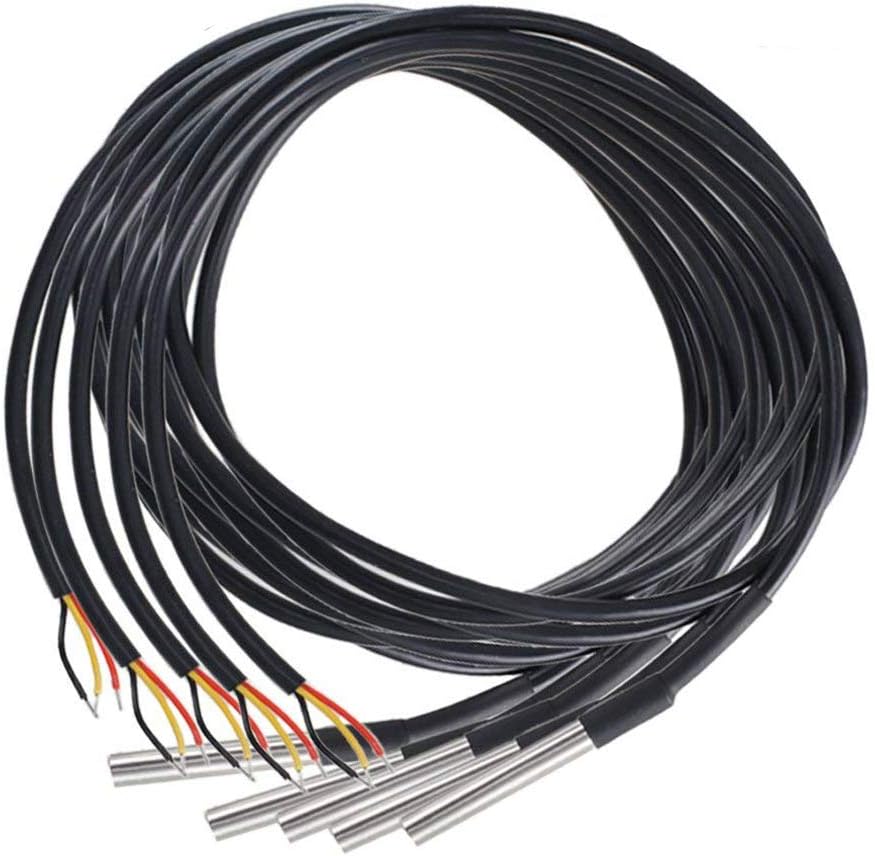
This five-piece set provides stainless steel waterproof probes ideal for durable temperature sensing in harsh environments. It uses the standard DS18B20 sensor known for digital accuracy and wide range.
We may earn a commission when you buy through this link, at no additional cost to you.
The waterproof seal ensures protection against water and moisture damage. You can measure from minus fifty-five to one hundred twenty-five degrees across various industrial or agricultural applications.
The single-wire interface simplifies wiring when using multiple sensors together on a common bus. The five-pack quantity is excellent for projects requiring many measurement points.
Use this for bulk monitoring tasks where durability and cost matter. It is a solid choice for commercial growers or facility managers.
The stainless steel package protects the internal electronics from physical damage.
All five sensors can share a single wire to the microcontroller with proper configuration.
We may earn a commission when you buy through this link, at no additional cost to you.
Selecting the right sensor involves considering accuracy, interface, range, and environmental resistance based on your project needs.
Accuracy determines how close the reading is to the actual temperature. Higher precision sensors like the SHT31-D offer plus or minus zero point three degrees while basic modules may vary by two degrees.
For scientific or industrial use, prioritize sensors with tight error margins. Hobby projects can often tolerate wider tolerances to save costs.
Protocols like I2C, single-wire digital, and 1-Wire differ in wiring complexity and pin usage. Single-wire options save GPIO pins but may be slower than I2C interfaces.
Choose a protocol that matches your available pins and library support. Simple digital outputs are easier for beginners, while I2C offers speed and reliability.
Ensure the sensor covers the temperature span of your environment. Basic indoor sensors typically operate between zero and fifty degrees while advanced probes handle wider spans.
If your project involves freezing or high-heat conditions, verify the sensor meets those limits. Operating outside ranges can damage the device permanently.
Waterproof or corrosion-resistant designs are essential for outdoor, liquid, or industrial settings. Stainless steel probes offer better protection than standard plastic modules.
Check the rating for submersion or humidity limits. Proper protection ensures longevity in harsh conditions.
Verify the sensor works with your specific microcontroller board. Most sensors work with 3.3V or 5V logic, but voltage mismatch can cause errors.
Review pinout requirements to avoid conflicts with other peripherals. Compatibility ensures seamless integration.
Some packages include resistors, wires, and adapter boards to simplify setup. Others require sourcing these separately, increasing effort and cost.
For beginners, all-in-one kits reduce assembly errors. Advanced users may prefer bare modules for custom wiring.
Quality sensors maintain accuracy over time without frequent calibration. Look for models with stable long-term performance ratings.
Stability is crucial for logging applications. Poor drift can invalidate historical data.
Connect the sensor to your board using the specified pins and wiring scheme. Ensure power levels match the voltage requirements to avoid hardware issues.
Install the appropriate library for your microcontroller to process digital outputs. Test readings in a stable environment to confirm accuracy before deployment.
Protect the sensor from moisture unless waterproof rated. Regularly check connections to ensure consistent operation over time.
For indoor use, the DHT11 or DHT22 offers excellent value with basic precision. They are affordable and easy to integrate for climate tracking.
Only waterproof probes like the DS18B20 stainless steel versions should be used underwater. Standard modules will fail if submerged.
You can connect multiple 1-Wire sensors on one data pin using unique addresses. I2C allows multiple devices on a bus as well.
Some sensors include pull-up resistors while others require external ones. Always check the product details to confirm if components are included.
Digital sensors output binary data directly while analog sensors need conversion. Digital options are more common for Arduino due to easier processing.
Fluctuations may result from noise or power issues. Ensure stable power and use proper filtering code to smooth the data.
Our selection includes top options from budget DHT11 modules to premium waterproof probes. Each serves a distinct purpose based on your project requirements.
Prioritize accuracy and environmental resistance if reliability is critical. For simple tasks, basic digital sensors provide sufficient performance.
Always verify current availability and pricing on the vendor site before purchasing. Specifications may vary slightly between batches and regions.