
KK 2.1.5 Flight Control Board
5.0Editor score
Affordable self-balancing control
Supports V-tail aircraft designs
Simple hobbyist-friendly interface
This guide compares the top flight controllers for hybrid Vtol and Vtol drones, evaluating performance, firmware support, and compatibility for reliable
Flight controllers serve as the brain of modern unmanned aerial vehicles, especially for complex hybrid configurations like vertical takeoff and landing systems. Choosing the right board ensures stability during transition phases between hover and forward flight modes.
We evaluated ten leading flight controllers based on processor speed, sensor redundancy, firmware compatibility, and specific support for VTOL mission profiles. Our analysis focuses on models that handle mixed motor types and complex control laws effectively.
Each pick highlights unique strengths ranging from budget-friendly options to enterprise-grade autopilots suitable for research and commercial deployment. Note that availability and pricing may fluctuate depending on current market conditions and vendor stock levels.
5.0Editor score

4.8Editor score
3.7Editor score
The following table provides a side-by-side comparison of all ten selected flight controllers, highlighting key specifications such as processor type, supported power ranges, and specific VTOL capabilities to help you make an informed decision.



The Pixhawk 2.4.8 is a proven open source flight controller designed for diverse aircraft types including fixed-wing and multi-rotor platforms. It comes with a strong reputation among hobbyists and researchers who value customizable firmware and reliable autopilot capabilities for complex missions.
We may earn a commission when you buy through this link, at no additional cost to you.
This unit features an advanced 32-bit ARM Cortex M4 core that handles heavy computational loads efficiently. Its fail-safe co-processor ensures critical operations remain stable even under stress. The included GPS module enhances navigation accuracy for long-range autonomous flights without requiring additional purchases.
While powerful, the Pixhawk requires careful configuration and calibration steps to function optimally. Beginners might find the initial setup slightly daunting compared to plug-and-play alternatives. However, these trade-offs are acceptable for users who demand full control over flight parameters and mission logic.
This controller is best suited for developers and serious hobbyists building custom UAVs for research or commercial tasks. If you need a reliable foundation for experimentation and want support for a wide range of peripherals, this is a top-tier choice.
The open source nature allows users to modify code and integrate custom modules for unique project needs.
Built-in fail-safes and GPS integration provide a stable platform for autonomous waypoint navigation and recovery.
We may earn a commission when you buy through this link, at no additional cost to you.
The KK 2.1.5 offers a straightforward solution for hobbyists looking to build model aircraft with basic flight stabilization. It is particularly noted for supporting VTOL and V-tail designs at a very low cost, making it accessible for entry-level projects.
We may earn a commission when you buy through this link, at no additional cost to you.
This controller excels in providing stable flight control without complex configuration requirements. Its self-balancing feature helps maintain orientation during flight which is crucial for new pilots learning to manage mixed-mode aircraft like VTOL platforms.
The simplicity of the KK 2.1.5 is both a strength and a limitation. While it is easy to set up it lacks the advanced telemetry and automation found in higher-end boards. This is acceptable for users focused on manual flight skills rather than full autonomy.
We recommend this board for beginners or those building simple experimental VTOL frames on a tight budget. If your priority is learning flight dynamics without spending much on electronics this remains a solid choice for your build.
Designed specifically to handle the unique motor mixing required for vertical takeoff and tail configurations.
An LCD menu system allows users to tweak settings directly on the board without needing a computer connection.
We may earn a commission when you buy through this link, at no additional cost to you.
The COREWING F405 V2 is a compact flight controller tailored for RC airplanes and drone builds where weight is a critical factor. It leverages the F405 processor to deliver responsive control outputs suitable for various flight profiles and configurations.
We may earn a commission when you buy through this link, at no additional cost to you.
Its small footprint allows for easy installation in tight spaces within an airframe which is particularly beneficial for smaller fixed-wing or VTOL hybrid designs. The lightweight nature ensures it does not compromise the balance of the aircraft during flight.
While versatile, the product description emphasizes RC airplane compatibility over advanced autonomous VTOL features. This means users may need to perform additional manual setup for complex multi-mode operations. It is best for builds that prioritize manual flight over full automation.
This board is a practical choice for modelers building lightweight RC planes or simple hybrids. If you need a fast reliable controller that fits into a small frame and supports standard RC protocols this unit fits the bill well.
Designed to minimize added weight so that the aircraft maintains optimal lift-to-weight ratios for better endurance.
The F405 chip provides sufficient processing power to handle standard stabilization and mixing tasks reliably.
We may earn a commission when you buy through this link, at no additional cost to you.
The PIX 2-12S is a capable flight controller designed to handle both multirotor and VTOL missions with a high degree of flexibility. It supports a wide power range up to 12S which is valuable for high-performance electric systems requiring more voltage and power.
We may earn a commission when you buy through this link, at no additional cost to you.
This board integrates a quality STM32F405VGT6 main controller along with essential sensors like a gyroscope and magnetometer. These components work together to provide precise orientation data which is vital for maintaining stability during the transition phases of VTOL flight.
Installation involves connecting various receivers via connectors for Mavlink SBUS PPM or CRSF. While this offers flexibility users must be comfortable with basic wiring and configuration to get the most out of the system. It excludes the ESC so you must source that separately.
This controller is suitable for builders seeking a stable core board for custom autonomous systems. If you need a platform that supports advanced telemetry protocols and wide voltage ranges for larger battery setups this is a strong candidate for your build.
Supports 2 to 12S LiPo batteries which allows for scaling up motor systems without changing the controller.
Built-in magnetometer and gyroscope ensure accurate heading and tilt readings for smooth autonomous flight paths.
We may earn a commission when you buy through this link, at no additional cost to you.
The F405 Wing Flight Controller is specifically tailored for fixed-wing drones that include VTOL capabilities. It leverages the popular Ardupilot firmware which is well known for its comprehensive support of hybrid flight modes and autonomous mission planning.
We may earn a commission when you buy through this link, at no additional cost to you.
Users can easily configure and monitor flight parameters using a smartphone app which simplifies the tuning process significantly. This user-friendly setup is beneficial for both beginners and experienced pilots who want to spend more time flying than configuring hardware.
While it is compact and lightweight the specific hardware limits are not fully detailed in the provided data. However the focus on fixed wing VTOL makes it a niche choice for those building flying wings or hybrid airframes that require specific stabilization.
This unit is ideal for anyone focusing on fixed wing VTOL builds using Ardupilot. The app control feature makes it stand out as a convenient option for those who prefer mobile interfaces for managing their flight stack settings and telemetry.
Allows users to adjust settings and monitor status directly from a mobile device without needing a laptop.
Built-in algorithms are tuned specifically for the aerodynamic characteristics of fixed wing and VTOL hybrids.
We may earn a commission when you buy through this link, at no additional cost to you.
This stack combines the CORVON H743 Flight Controller with a powerful 60A ESC to deliver high performance for demanding flight applications. The H743 processor runs at 480MHz providing ample computing power for complex control loops and sensor fusion tasks.
We may earn a commission when you buy through this link, at no additional cost to you.
It includes dual IMUs which enhance reliability by providing redundant sensor data. This is particularly useful for maintaining stability in high-vibration environments. The ESC supports up to 8S LiPo batteries and delivers strong burst current for aggressive throttle responses.
While marketed for FPV and racing drones the hardware compatibility with PX4 and Ardupilot makes it viable for VTOL projects. Users must ensure the specific VTOL parameters are configured correctly as this board is optimized for agility over heavy lifting.
For builders wanting a top-tier stack with powerful motor control and sensor redundancy this is an excellent choice. The wide range of firmware support allows you to adapt the board to various flight styles including hybrid VTOL configurations with the right tuning.
Using two inertial measurement units helps filter noise and prevent control failures due to sensor errors.
Support for Betaflight INAV and PX4 means you can switch between racing and autonomous modes easily.
We may earn a commission when you buy through this link, at no additional cost to you.
This stack features the same high-speed H743 processor as the 60A version but pairs it with a 50A ESC designed for lighter frames. It supports 2 to 6S batteries which is ideal for small agile drones that do not require massive power output.
We may earn a commission when you buy through this link, at no additional cost to you.
The lightweight design of the stack helps keep the overall weight down which improves flight time and maneuverability. It also includes dual IMUs and a compass which are essential for maintaining orientation and stability in varied flight environments.
Although it supports multiple firmware options the 8 bit ESC limits some advanced motor control features. This trade-off is acceptable for builds that prioritize speed and agility over heavy payload capacity. It is a solid option for racing and light freestyle VTOL builds.
If you are building a smaller drone or need a fast responsive board for racing and VTOL this stack is a good fit. The integration of key sensors in a compact form factor makes it easy to install in tight frames without clutter.
The entire stack is designed to minimize weight ensuring better performance for lighter airframe builds.
Support for high-frequency protocols allows for smooth and precise throttle control during maneuvers.
We may earn a commission when you buy through this link, at no additional cost to you.
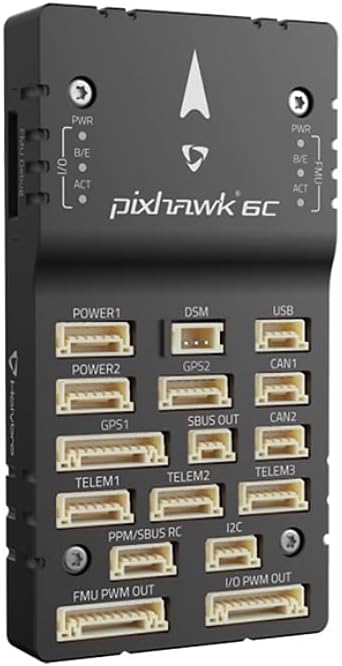
The Pixhawk 6C is a high-end flight controller designed for serious developers and academic research projects. It features a dual redundant IMU system with temperature control to ensure consistent performance even in challenging environmental conditions.
We may earn a commission when you buy through this link, at no additional cost to you.
Its onboard vibration isolation system effectively filters out high-frequency noise from motors and props. This leads to cleaner sensor data and more precise flight control which is critical for autonomous missions and high-accuracy data collection tasks.
Powered by a 480MHz H7 processor the board delivers massive computing power for complex algorithms. The plastic case version is lightweight and cost-effective but users should handle it with care as the aluminum case is more durable for rougher handling.
This controller is best for universities and professional labs building custom autonomous UAVs. If you need a reliable robust platform with advanced sensor redundancy and strong PX4 support this represents the premium end of the market.
Built-in dampening reduces sensor noise ensuring accurate altitude and orientation readings during flight.
Two independent IMUs provide a safety net against sensor failure which is vital for commercial operations.
We may earn a commission when you buy through this link, at no additional cost to you.
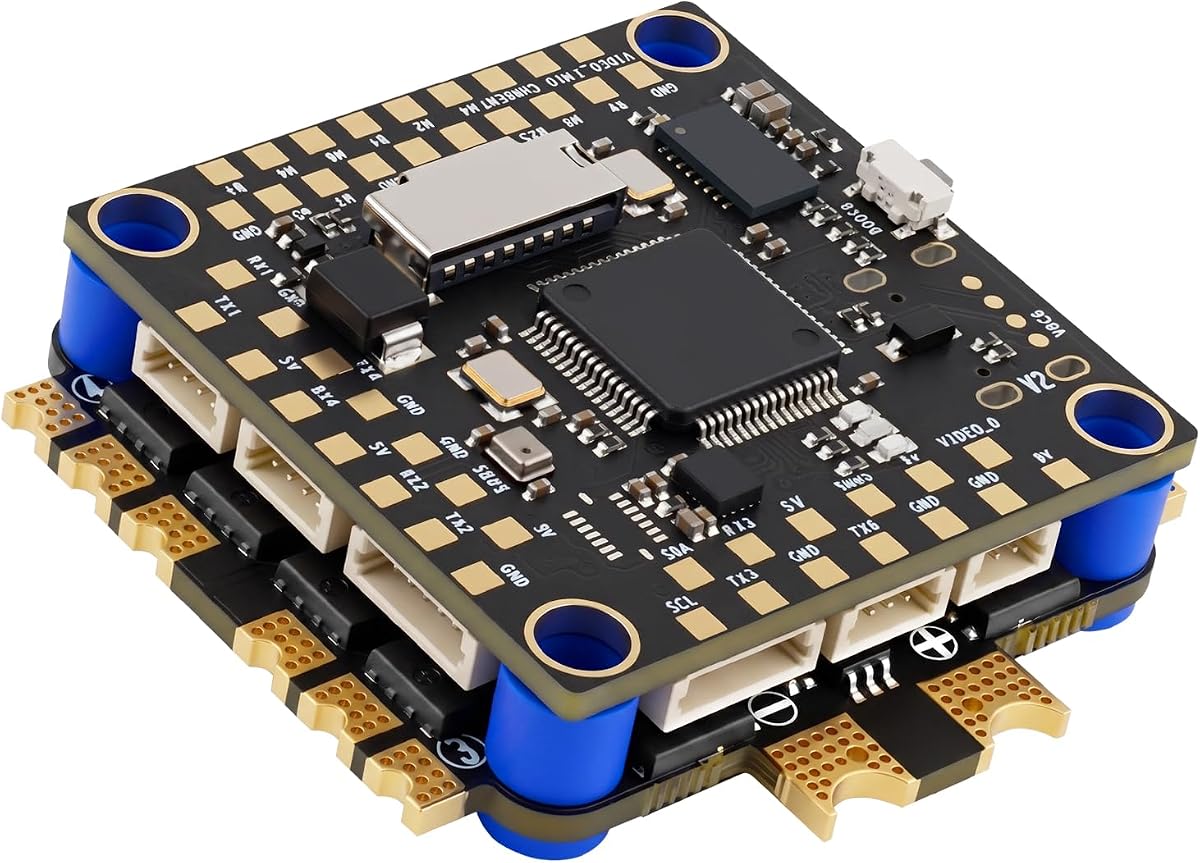
The AERO SELFIE F405NC stack offers a reliable combination of a flight controller and ESC suitable for lightweight builds. It features a 168MHz F405 processor which is capable enough for many VTOL applications and basic autonomous tasks.
We may earn a commission when you buy through this link, at no additional cost to you.
This unit stands out with its dual IMU configuration and DPS310 barometer which provide stable altitude hold. The compatibility with Betaflight INAV and Ardupilot allows flexibility in choosing the right firmware for your specific mission profile.
While the ESC is 8 bit it still provides continuous 60A current which is plenty for most hobby grade drones. The setup process is streamlined with quick configuration options making it accessible for beginners as well as seasoned pilots.
We recommend this stack for users building small FPV or racing VTOL drones who need decent performance at a fair price. The inclusion of quality sensors in a compact stack makes it a practical choice for a versatile build.
Dual IMUs ensure that attitude data remains consistent and reliable even when one sensor drifts.
A high precision barometer helps maintain steady altitude during flight even in windy conditions.
We may earn a commission when you buy through this link, at no additional cost to you.
This stack features the AERO SELFIE H743 Flight Controller with a powerful 32 bit ESC designed for high performance applications. The H743 processor delivers massive speed for demanding flight tasks which is beneficial for complex control laws and autonomous operations.
We may earn a commission when you buy through this link, at no additional cost to you.
It supports a wide range of batteries up to 6S and includes essential sensors like a compass and barometer. The 32 bit ESC ensures precise motor control and reduces power loss which is important for efficiency during long endurance VTOL flights.
While the user rating suggests some mixed feedback the hardware specs are robust for the price. Users should be prepared to troubleshoot minor configuration issues if they occur during initial setup. For those seeking performance this is a strong contender.
We recommend this stack for builders who need raw processing power and reliable motor control in a compact package. If you plan to run complex firmware like PX4 or Ardupilot this hardware provides the speed needed for smooth operation.
A 32 bit ESC offers smoother throttle curves and better efficiency compared to older 8 bit controllers.
The 480MHz processor handles complex calculations for navigation and stabilization in real-time.
We may earn a commission when you buy through this link, at no additional cost to you.
Selecting the right flight controller for hybrid VTOL builds requires balancing performance compatibility and future expandability. This section covers the critical factors you should evaluate before making a purchase.
A fast processor ensures the board can handle complex mixing calculations required for transitioning between hover and forward flight without lag. Look for modern chips like STM32F4 or H7 series to ensure responsive control.
Prioritize boards with at least a 400MHz processor for advanced autonomous tasks and heavy sensor loads.
VTOL systems rely heavily on specific flight stacks like Ardupilot or PX4 which have specialized VTOL modes. Ensure the board you choose is officially supported by the firmware you plan to use.
Check community forums and manufacturer sites to confirm that VTOL parameter tuning is fully available for your selected controller.
High quality IMUs and barometers are essential for stability especially during the critical transition phase of VTOL flight. Redundant sensors can prevent crashes caused by single-point failures.
Look for dual IMU configurations and high precision barometers to ensure accurate altitude and orientation data.
Hybrid VTOLs often require higher voltage and current capabilities than standard drones. Ensure your controller and ESC stack can handle the power demands of your motors safely.
Choose a stack that supports the voltage range of your battery and offers sufficient current headroom for peak bursts.
VTOL builds often integrate telemetry GPS and other sensors that need dedicated UART ports. A controller with ample ports prevents the need for splitters or complex wiring.
Select a board with at least five UART ports to accommodate GPS telemetry and receiver connections easily.
The physical size of the board matters for fitting into the airframe without obstructing airflow or adding excessive weight. Look for standardized mounting patterns like 20×20 or 30x30mm.
Verify the dimensions match your frame and that the board fits securely with vibration dampening if needed.
For beginners or those without deep technical backgrounds boards with mobile app support or clear documentation save significant time. Complex boards may require extensive configuration and coding knowledge.
If you are new to VTOL pick a board with clear guides or app-based configuration options for a smoother start.
Consider whether you plan to add cameras lights or additional autonomy modules later. A controller with CAN bus or extra I2C ports allows for easier future upgrades.
Choose a flight controller with expansion capabilities to accommodate new sensors or hardware as your project grows.
Install the flight controller securely in a vibration-dampened mount to prevent sensor errors caused by motor noise. Ensure all power and signal cables are neatly routed and secured to avoid interference or disconnection during flight.
Calibrate all sensors including accelerometers gyroscopes and magnetometers before your first flight. Use the associated software to run calibration routines and verify that sensor readings are stable and accurate in various orientations.
Keep the firmware updated to the latest version supported by your hardware to benefit from bug fixes and new features. Regularly inspect the board for signs of damage or loose connections especially after heavy landings or crashes.
A VTOL suitable controller must support specific firmware features that handle motor mixing between fixed wing and multirotor modes. It should have high processing power for complex calculations and sufficient sensor redundancy to maintain stability during transition phases.
Standard controllers often lack the specific mixing parameters required for VTOL transitions. You generally need a board that supports advanced stacks like Ardupilot or PX4 which have built-in VTOL modes for seamless switching.
Processor speed is critical because VTOL transitions require rapid calculations to adjust motor speeds in real time. A slower board may struggle to maintain stability during these high-dynamic phases leading to crashes or poor performance.
For autonomous VTOL flights a GPS module is essential to provide position data for waypoint navigation and loiter modes. Even for manual flying GPS helps with return to home features and precise hold capabilities.
Dual IMUs provide redundancy so if one sensor fails or drifts the system can rely on the other to maintain accurate attitude data. This is especially important for large or high-value VTOL projects where crash prevention is critical.
Ardupilot and PX4 are the leading firmware options for VTOL due to their comprehensive VTOL modes and large communities. They offer extensive support for various VTOL configurations and allow deep customization for specific hardware.
Use rubber grommets or foam mounts to isolate the board from the airframe. High frequency vibrations from motors can corrupt sensor data so mechanical isolation is key to stable flight performance.
A 32 bit ESC offers finer control over motor speed which is beneficial for smooth transitions. It is more efficient and provides better performance for VTOL builds that require precise throttle management during flight.
In this guide we reviewed ten distinct flight controllers ranging from budget hobbyist boards to premium research grade autopilots. Each option offers unique strengths whether you prioritize cost simplicity or advanced autonomous capabilities.
When making your decision prioritize the firmware compatibility and processing power needed for your specific mission profile. A controller that fits your current needs should also allow room for future expansion and upgrades.
Remember that prices and availability can change frequently so check the latest listings and vendor offers before purchasing. Taking the time to choose the right board now will save you effort and ensure a smoother flight experience later.