
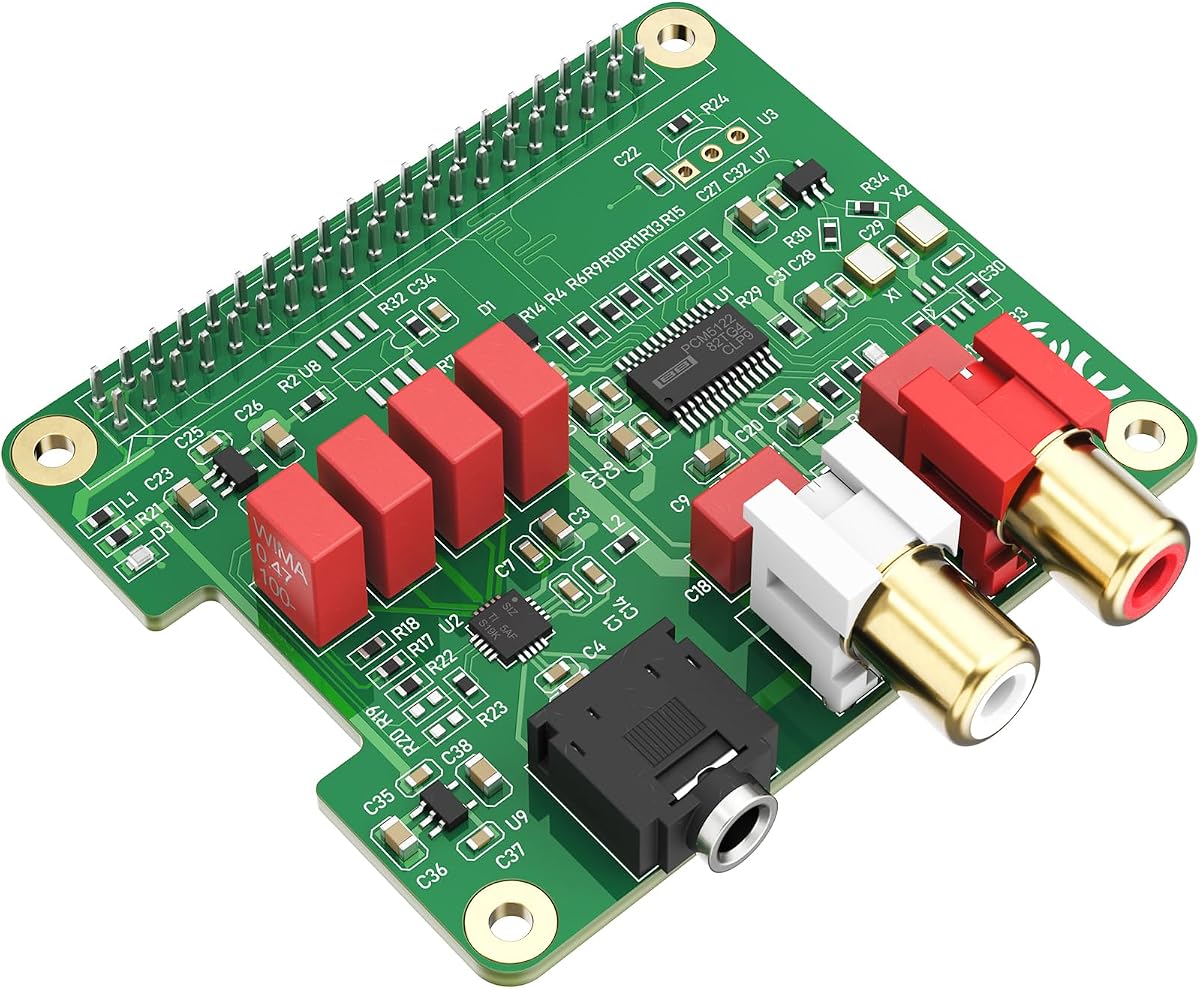
HiFi DAC Audio Sound Card Module PCM5122
4.8Editor score
I2S interface support
384KHz sampling rate
LED status indicators
Infrared receiver interface
Affordable entry level option
This guide compares the top 10 DAC for Raspberry Pi models featuring high resolution audio support dual outputs and software compatibility for audiophile grade
Enhancing your Raspberry Pi with a dedicated DAC unlocks studio grade audio quality that built in chips cannot match. These boards convert digital signals into analog sound with precision reducing noise and distortion for immersive listening experiences.
We evaluated ten top rated models based on chip performance compatibility with popular media players and output options. Each entry was assessed for build quality jitter reduction software support and value to help you find the perfect audio upgrade for your setup.
Every pick highlights key strengths ideal use cases and specific technical advantages for different listener needs. Please note that availability and pricing can shift frequently so verify current details before finalizing your purchase decision today.
4.8Editor score
4.5Editor score

4.5Editor score
The following table provides a side by side overview of all ten selected models highlighting their core specifications and primary advantages to simplify your selection process.


This HAT delivers professional audio quality through its PCM5122 chip and dual clock system making it the top choice for serious listeners. It integrates seamlessly via GPIO and supports high resolution files without introducing digital noise or jitter artifacts.
We may earn a commission when you buy through this link, at no additional cost to you.
The dual ultra-low jitter oscillators ensure precise timing which is critical for maintaining signal integrity across sample rates. Coupled with film capacitors and independent grounding the board produces clean outputs that drive headphones and line-level systems effectively.
While it lacks balanced outputs this model focuses on delivering maximum clarity within stereo limits. The onboard EEPROM simplifies setup and works flawlessly with popular music servers ensuring you spend more time listening and less time configuring.
Buyers seeking a balance of performance and ease of use should prioritize this board. It transforms any Pi into a reliable audio streamer capable of handling demanding files with transparency and depth.
Dual oscillators eliminate timing errors from the Pi to preserve audio timing accuracy.
Gold-plated RCA and a headphone amp provide flexible connections for various speakers.
We may earn a commission when you buy through this link, at no additional cost to you.
Engineered specifically for compact models this shield maintains full feature parity without overhanging edges. It retains the reliable PCM5122 core ensuring high resolution playback even on small form factor devices.
We may earn a commission when you buy through this link, at no additional cost to you.
The TPA6133 amplifier offers robust power for headphones while the dual outputs allow flexible integration into existing systems. This combination makes it ideal for portable setups where space is limited but quality cannot be sacrificed.
Performance matches larger boards in terms of clarity though build materials remain modest. The low noise floor ensures quiet backgrounds during playback which is a key trait for audiophile applications.
Choose this if you need a fit for Zero models or want a no fuss upgrade. It delivers exceptional value by prioritizing core audio performance over extra bells and whistles.
Designed to fit Zero boards without overhang for clean enclosure integration.
TPA6133 chip drives headphones cleanly even at lower impedance levels.
We may earn a commission when you buy through this link, at no additional cost to you.
This board elevates audio performance with the flagship ES9038Q2M converter offering unmatched clarity and dynamic range. It supports the highest resolution formats available today ensuring no detail is lost in translation.
We may earn a commission when you buy through this link, at no additional cost to you.
The dual ultra-low jitter clocks combined with three dedicated op amps create a robust analog stage capable of driving demanding loads. Balanced outputs provide superior noise rejection for professional studio monitoring or high-end home systems.
While the price reflects its premium components the value lies in future-proofing your system. The extensive documentation and dedicated Wiki support help you maximize these capabilities without needing deep technical expertise.
Audiophiles seeking the absolute best should invest in this model. Its technical prowess ensures that even the most demanding recordings are reproduced with pristine accuracy and depth.
ESS ES9038Q2M delivers industry-leading noise performance and resolution.
XLR outputs reduce interference for clean signal transmission to amps.
We may earn a commission when you buy through this link, at no additional cost to you.
Focused on digital transmission this hat ensures signal purity through galvanic isolation and precision clocking. It offloads audio processing to external DACs which simplifies the Pi's role and enhances stability.
We may earn a commission when you buy through this link, at no additional cost to you.
The industrial-grade isolator protects downstream equipment while the dual external crystals maintain timing accuracy across different sample rates. This makes it ideal for systems where noise reduction is paramount.
Unlike analog boards this unit requires an external decoder but delivers unmatched signal integrity. The bit-perfect output ensures no data alteration occurs during transmission which is critical for high-fidelity chains.
Select this if you already have a high-quality external DAC. It serves as the perfect bridge ensuring your digital source performs at its absolute peak without interference.
Physical separation of power and signals eliminates ground loop noise.
TOSLINK connection allows noise-free transmission over fiber optic cables.
We may earn a commission when you buy through this link, at no additional cost to you.
This module provides a straightforward path to high resolution audio at a minimal price point. The PCM5122 chip handles decoding tasks efficiently while status LEDs offer immediate feedback on system operation.
We may earn a commission when you buy through this link, at no additional cost to you.
With dedicated GPIO support for infrared control it remains versatile for remote-controlled setups. The I2S interface ensures digital purity before conversion maintaining clarity across playback modes.
Though it lacks premium features like balanced outputs its reliability is impressive for the price. It handles standard streaming tasks effortlessly making it a solid choice for beginners.
Ideal for first-time builders this board offers a risk-free introduction to Pi audio upgrades. It proves that even budget options can deliver significant improvements over onboard solutions.
Dual LEDs show power and decoding status for easy troubleshooting.
Reserved GPIO26 allows direct integration of infrared remote receivers.
We may earn a commission when you buy through this link, at no additional cost to you.
This hat emphasizes ease of use through onboard EEPROM that handles configuration without extra software. It ensures immediate functionality across generations of Raspberry Pi hardware which is rare in this category.
We may earn a commission when you buy through this link, at no additional cost to you.
Performance benefits from high precision components delivering a low noise floor for clean output. The dual interface supports both casual headphone listening and connected speaker setups effectively.
While documentation is concise the simplicity of the design minimizes potential configuration issues. It stands out as a reliable option for users who value quick setup over extensive tweaking.
Choose this if you want a plug-and-play experience across multiple projects. It bridges the gap between technical complexity and immediate audio enjoyment seamlessly.
EEPROM chip manages settings to ensure instant operation on boot.
Universal GPIO alignment ensures compatibility from Zero to Pi 5.
We may earn a commission when you buy through this link, at no additional cost to you.
Specifically engineered for the Pi 5 this board includes a ground loop isolator to combat electrical noise common in compact enclosures. This ensures a clean audio path which is vital for high-fidelity playback.
We may earn a commission when you buy through this link, at no additional cost to you.
Powered by the reliable PCM5122 it delivers robust performance in a streamlined package. The design prioritizes simplicity reducing installation steps so you can focus on sound quality rather than cabling.
While limited to a single output type it excels in its niche by minimizing potential interference sources. The 5.0 rating reflects consistent performance and user satisfaction in real-world setups.
Ideal for modern Pi 5 builds this model addresses specific electrical challenges head on. It provides peace of mind for users prioritizing silent backgrounds and clear signal paths.
Ground loop isolator eliminates hum caused by electrical interference.
Tailored design ensures perfect fit and power compatibility for Pi 5.
We may earn a commission when you buy through this link, at no additional cost to you.
This board introduces onboard digital signal processing allowing users to adjust EQ and routing without external software. The 300MHz DSP engine provides real-time manipulation ensuring optimized sound tailored to your listening environment.
We may earn a commission when you buy through this link, at no additional cost to you.
It supports high sample rates up to 192kHz and can run independently of the Pi for dedicated tasks. This versatility makes it powerful for multi-channel setups or specialized streaming applications.
The advanced features require more setup time but offer unmatched flexibility. Users needing precise control over their audio chain will find these capabilities indispensable.
Opt for this if you require room correction or custom routing options. It combines conversion quality with processing power in a single comprehensive solution.
DSP allows fine-tuning frequencies to match speaker room acoustics.
Can operate without a Pi for dedicated audio server tasks.
We may earn a commission when you buy through this link, at no additional cost to you.
Providing dual digital outputs this card ensures compatibility with various external amplifiers and receivers. The bit-perfect stream guarantees that your data reaches the DAC untouched preserving the integrity of the source material.
We may earn a commission when you buy through this link, at no additional cost to you.
It supports up to 192kHz/24bit resolution delivering high-quality digital audio through both optical and coaxial connections. This dual approach offers flexibility for different room setups and equipment configurations.
While it does not include analog conversion it excels at transmission quality. The straightforward design minimizes points of failure ensuring reliable long-term operation.
Choose this if you want a dependable digital bridge to your existing audio system. It simplifies integration while maintaining high performance standards across all formats.
Both Toslink and Coax outputs allow maximum flexibility.
Ensures raw audio data arrives at external devices unchanged.
We may earn a commission when you buy through this link, at no additional cost to you.
This module offers a cost-effective entry into digital audio conversion with its PCM5102A chip. It simplifies the process by including a soldered stereo jack so no additional wiring is required for basic headphone use.
We may earn a commission when you buy through this link, at no additional cost to you.
Despite its simple build it delivers lossless playback that far exceeds onboard options. The I2S interface ensures digital precision maintaining sound integrity from source to output.
While it lacks advanced features it serves well for projects needing basic audio enhancement. Its low price makes it an attractive option for testing or prototyping.
Choose this for budget-conscious projects requiring basic analog output. It proves that even simple modules can provide significant improvements over standard hardware.
Pre-soldered 3.5mm jack simplifies connection to headphones.
Digital interface ensures clean transmission without noise.
We may earn a commission when you buy through this link, at no additional cost to you.
Selecting the right DAC depends on your specific audio needs budget and setup constraints. This section outlines the critical factors to evaluate before making your decision.
The core DAC chip determines sound quality resolution and dynamic range. Chips like the ES9038Q2M offer superior precision compared to entry-level PCM chips.
Prioritize high-performance converters if you value clarity detail and low distortion in your playback.
Evaluate whether you need RCA line-out 3.5mm headphone jacks or balanced XLR connections. Some boards focus on stereo while others provide dedicated outputs for professional setups.
Match the output type to your existing amplification or speaker system for seamless integration.
Ensure the HAT works with your preferred media player software such as Volumio Moode or RuneAudio. Boards with EEPROM support simplify configuration and reduce setup friction.
Check compatibility lists to guarantee plug-and-play functionality with your chosen operating system.
Independent clock oscillators eliminate timing errors from the Raspberry Pi improving signal accuracy. Dual oscillators are preferred for maintaining stability across high-resolution files.
Look for boards that mention master-clock modes or external crystal designs for better timing integrity.
Consider the physical footprint especially if using smaller models like the Pi Zero. Some boards are designed to fit without overhang while others require larger enclosures.
Verify dimensions and pin alignment to ensure a secure fit within your intended case.
If using headphones check the onboard amplifier power rating. Boards with dedicated headphone chips deliver sufficient current for high-impedance loads without distortion.
Select models with robust amp specs if you plan to drive demanding headphones directly.
Extra capabilities such as digital isolation infrared ports or DSP processing add versatility. These features can reduce noise or allow advanced signal manipulation.
Assess whether these additions justify the cost based on your specific usage requirements.
Balance your budget with the features you need most. Entry-level boards offer significant improvements over onboard audio while premium models provide professional-grade performance.
Focus on core audio capabilities rather than unnecessary extras to maximize value for your setup.
Begin by powering off your Raspberry Pi before plugging in the DAC board to prevent electrical shorts. Align the 40-pin GPIO header carefully and press down gently until the board is fully seated.
Next enable the I2S interface in your operating system settings using raspi-config or the appropriate config file. Reboot the device so the system recognizes the new audio hardware automatically.
After booting install your preferred media player software and configure it to output audio via the HAT. Periodically check for firmware updates and keep connections clean to ensure consistent performance over time.
Most modern HATs connect directly to the GPIO header without requiring soldering. Simply align the pins carefully and press the board into place. If you are using older models you might need to solder header pins first but standard designs avoid this step.
Yes many DAC HATs are compatible with the Pi Zero provided the physical fit is managed correctly. Some boards are specifically designed to match the Zero compact form factor while others may need custom cases to avoid overhang.
A dedicated HAT bypasses the USB bus reducing potential electrical noise and jitter. This direct connection to the processor via I2S results in cleaner signal paths and more accurate timing for high-resolution audio files.
Popular media players like Volumio Moode and RuneAudio offer built-in support for most HATs. These systems handle device detection and driver configuration automatically making setup straightforward for users.
Use a DAC board with external clock oscillators which eliminate reliance on the Pi internal timing. Additionally ensure your power supply is stable as voltage fluctuations can introduce noise into the audio signal path.
Most boards work seamlessly with Spotify Connect and Tidal through supported software like Moode or Volumio. Ensure your chosen player explicitly supports the DAC chip for full functionality and control.
Using a case protects the hardware from physical damage and dust accumulation. Ensure the case has enough clearance for the board height and ventilation to prevent overheating during long listening sessions.
RCA outputs provide line-level signals suitable for amplifiers while 3.5mm jacks often include built-in headphone amplification. Use RCA for passive speakers and 3.5mm for direct headphone listening.
Our top three picks cover the essential needs for audiophiles budget builders and advanced users. The HiFi DAC HAT offers the best balance of performance while the Mini Hat serves compact setups effectively.
Prioritize boards with independent clocking and compatible software to ensure your system performs reliably. Whether you choose a basic module or a flagship DSP unit the upgrade will transform your listening experience.
Always check current availability and compatibility details before purchasing to ensure a smooth integration. With the right choice your Raspberry Pi becomes a powerful and versatile audio streaming hub.