
Low Noise RF Amplifier 0.1-2000MHz 32dB Gain LNA Broadband Amplifier 9-12V 27mA for CB Radio Shortwave FM SDR Ham Radio
4.2Editor score
Wideband 0.1 to 2GHz
32dB High Gain
Low 27mA Power Use
Multiple Radio Applications
Discover the top ham radio amplifier for boosting signal options reviewed in this comprehensive guide comparing features performance and compatibility.
Finding the right ham radio amplifier for boosting signal is essential for clear communication across long distances. Whether you operate in remote areas or dense urban environments, a quality amplifier enhances reception and transmission quality significantly.
We evaluated ten top products based on gain, frequency range, power output, and build quality. Our comparison covers everything from low noise receivers to high power linear amplifiers for various ham radio setups.
Each pick highlights key specifications and ideal use cases to help you decide. Note that prices and availability change frequently, so verify current details before purchasing your next amplifier upgrade today.
4.2Editor score

4.2Editor score

3.1Editor score
This side-by-side comparison outlines key specifications and capabilities for each amplifier to help you select the right model for your specific transmission or reception needs efficiently.




The Xiegu GPA100 is a powerful linear amplifier designed to boost low-power transceivers into 100W class stations. With a 4.2 rating, users praise its clean signal purity and reliable performance across multiple HF bands.
We may earn a commission when you buy through this link, at no additional cost to you.
Its standout feature is flexible band switching, offering manual buttons or auto mode that tracks your radio transitions seamlessly. The built-in Bluetooth allows wireless control with supported devices like the IC-705, eliminating extra cables for a tidy setup.
While highly capable, the GPA100 is optimized for HF operation and does not cover VHF or UHF. Users must provide their own power supply to ensure stable voltage delivery during extended transmissions.
This amplifier is ideal for operators wanting to expand QRP capabilities without complex wiring. If you prioritize stable amplification with minimal user intervention, the GPA100 stands out as a strong choice.
Bluetooth integration allows automatic band synchronization with compatible radios, streamlining transitions and reducing manual input during active sessions.
Advanced protection mechanisms monitor SWR, temperature, and current to prevent damage during high-stress operating conditions, ensuring long-term reliability.
We may earn a commission when you buy through this link, at no additional cost to you.
This low noise RF amplifier offers exceptional value for hobbyists seeking to enhance signal reception across a vast frequency range. With a 4.2 rating, it is widely used for CB, shortwave, and software defined radio applications.
We may earn a commission when you buy through this link, at no additional cost to you.
The device delivers 32dB gain with a low noise figure to improve weak signals significantly. It operates on 9 to 12V power and consumes only 27mA, making it battery friendly for portable field operations.
While excellent for receiving, it has limited power output compared to linear amplifiers. It should be used only on the receive side to avoid damage from high transmission power levels.
For operators looking to boost receiver sensitivity without a large investment, this unit provides a practical solution. Its versatile coverage ensures it works well with multiple communication bands and test equipment setups.
Covering from 0.1MHz to 2000MHz, this amplifier improves signal clarity across broadcast, amateur, and remote control frequencies effectively.
Low current draw allows operation on lithium batteries, making it ideal for field days or mobile installations without heavy power demands.
We may earn a commission when you buy through this link, at no additional cost to you.
The BJ-300 Plus is a robust linear amplifier capable of delivering up to 150W on SSB modes. While its rating is 3.1, it is popular among operators needing strong output power for long distance communication.
We may earn a commission when you buy through this link, at no additional cost to you.
It supports AM, FM, SSB, and CW modes with simple controls for power adjustment. The included cooling fan and aluminum heat sink ensure stable operation during extended transmission sessions without overheating.
Users must provide a proper power source and ensure good ventilation to maintain performance. The reverse polarity protection adds safety against accidental incorrect power connections.
This amplifier suits operators prioritizing raw power and versatility over compact design. If you need reliable amplification for HF transceivers and want strong output capabilities, this model is worth considering.
Delivers up to 150W SSB output extending your transmission range significantly for consistent contacts over longer distances.
Built-in polarity reversal protection and cooling safeguards protect the unit and your equipment from electrical faults and heat damage.
We may earn a commission when you buy through this link, at no additional cost to you.
This wideband LNA delivers exceptional reception quality from 10MHz to 6GHz, earning a perfect 5.0 rating for its clarity. It is optimized for SDR monitoring and modern ham radio setups requiring broad spectrum coverage.
We may earn a commission when you buy through this link, at no additional cost to you.
Featuring 30dB gain and a low noise figure, it strengthens weak signals effectively. The SMA female connectors match standard coaxial cables easily, and Type C power simplifies setup without needing adapters.
Operators should note that this module is strictly for receive applications. Feeding transmission power into it will cause permanent damage due to its low power handling capacity.
For scanning and wideband listening applications, this unit provides reliable signal boosting. Its aluminum housing ensures durability while maintaining stable performance across diverse frequency environments.
Supports up to 6GHz enabling clear reception of modern broadcast and experimental signals beyond traditional HF bands.
Type C USB power input offers versatile connections for portable or fixed installations without specialized power sources.
We may earn a commission when you buy through this link, at no additional cost to you.
Designed for field testing, this amplifier includes a built-in battery for up to five hours of operation. With a 3.8 rating, it is favored for portability and compatibility with tools like TinySA Ultra.
We may earn a commission when you buy through this link, at no additional cost to you.
The unit delivers 21dB gain across a massive range from 100kHz to 10GHz. Its rugged metal housing provides shielding against interference, ensuring clean measurements and signal detection in varied environments.
Users should avoid using it with other LNA modules simultaneously to prevent AGC compression. Also, do not use it in high noise urban areas without filtering for optimal results.
Ideal for engineers and hams needing a portable booster without power dependency, this unit simplifies outdoor tuning. Its ready-to-use kit ensures immediate deployment in the field.
Integrated battery eliminates need for external power banks allowing immediate signal enhancement wherever you operate.
Compact metal housing protects sensitive electronics during transport ensuring reliable performance in outdoor conditions.
We may earn a commission when you buy through this link, at no additional cost to you.
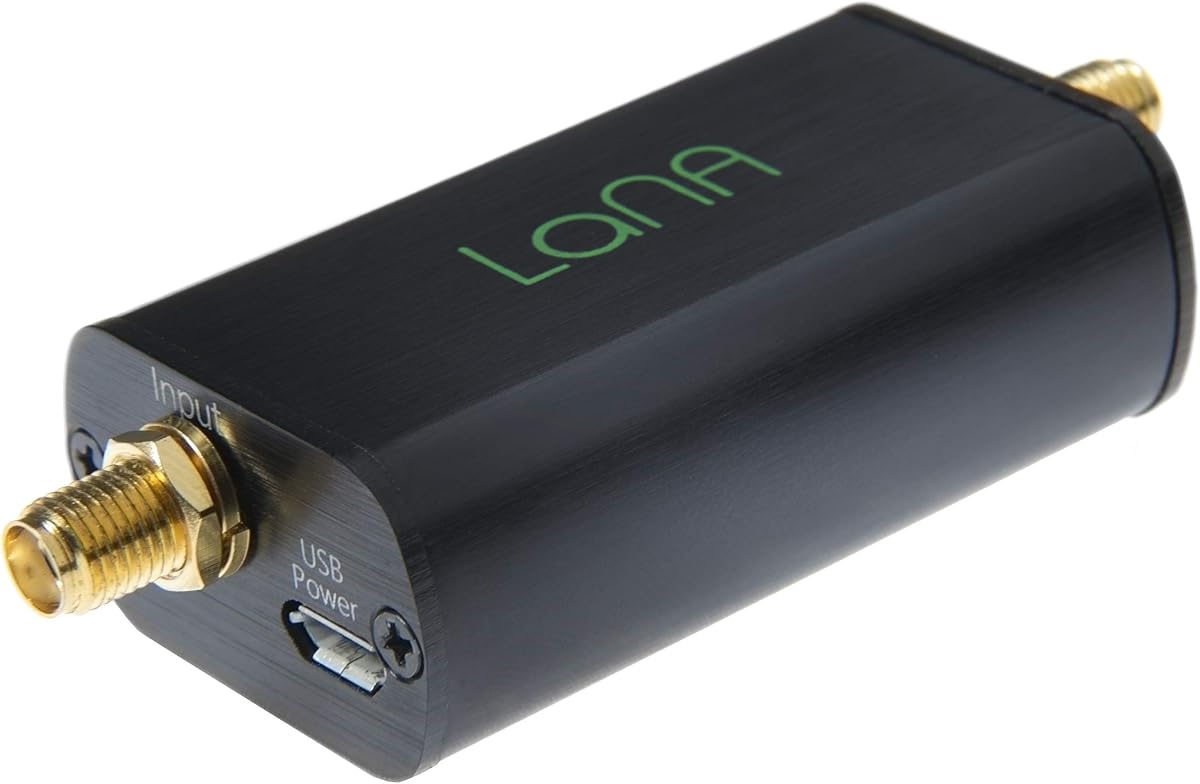
The Nooelec Lana provides ultra-low noise performance optimized for SDR reception. With a 4.2 rating, users note improved SNR and clearer signals compared to standard modules using similar ICs.
We may earn a commission when you buy through this link, at no additional cost to you.
It operates between 20MHz and 4GHz, covering most amateur and broadcast bands. Power is flexible via USB bias tee or DC adapter, and it includes an aluminum enclosure for thermal stability.
Some setups may require a DC block to protect connected devices. Always check your radio interface compatibility to avoid potential issues with power routing.
This amplifier is perfect for improving receiver front ends without sacrificing signal quality. Its compact design makes it suitable for permanent mounts or portable SDR kits alike.
Lower noise figure and linearity enhance weak signal detection critical for effective SDR and monitoring operations.
Supports bias tee or direct USB power enabling easy installation with many SDR dongles and receivers.
We may earn a commission when you buy through this link, at no additional cost to you.
This pre-amplifier is tailored for scanner receivers needing enhanced sensitivity. Rated 4.1, it covers the standard 25MHz to 2000MHz range used by police, fire, and emergency services.
We may earn a commission when you buy through this link, at no additional cost to you.
It uses a PP3 battery for power and includes a BNC patch lead. The 6 to 20dB gain helps bring in weak signals without excessive noise, ideal for urban or suburban scanning.
Users should replace batteries regularly to maintain consistent performance. While simple, it may not support high power transmission applications or amateur radio modes.
For enthusiasts focused on public safety listening, this amplifier offers reliable signal boost. Its BNC design simplifies integration with most standard scanner setups.
Frequency range matches standard public safety bands improving reception clarity for scanner monitoring tasks.
BNC connectors and included lead ensure quick connection without adapters or specialized tools.
We may earn a commission when you buy through this link, at no additional cost to you.
This preamp delivers exceptional signal clarity from 100kHz to 10GHz, earning a 4.9 rating. It is optimized for TinySA Ultra users seeking to improve high band performance significantly.
We may earn a commission when you buy through this link, at no additional cost to you.
The built-in high PSRR LDO suppresses power supply noise ensuring clean measurements. With 21dB gain at low noise, it replaces standard modules easily for better high frequency performance.
Avoid exceeding input power to prevent saturation or damage. Users should also keep it dry to avoid rust on the metal housing in humid conditions.
Ideal for precise measurement and high frequency reception, this module simplifies bench setups. Its USB interface removes external power dependencies for a streamlined workflow.
On-chip LDO design reduces supply noise enhancing spectral purity for accurate signal testing and monitoring.
Small shielded housing allows easy integration into portable test kits without adding bulk to your setup.
We may earn a commission when you buy through this link, at no additional cost to you.
This amplifier offers 150W SSB output with multiple safety features. Rated 3.1, it is suited for operators needing higher power to extend communication range significantly.
We may earn a commission when you buy through this link, at no additional cost to you.
It supports AM FM SSB and CW modes with simple controls. The cooling fan and heat sink prevent overheating during continuous use, while dual fuses protect against power surges.
Users must ensure 13.8V input is stable to avoid voltage drops. The reverse polarity protection ensures safe hookups to prevent damage from connection errors.
If you want strong output in a compact package, this unit delivers. Ensure your power source and antenna system are robust enough to handle the increased output levels.
Active cooling maintains safe operating temps during long transmission sessions protecting components from heat stress.
Polarity and fuse protection guard against common electrical errors ensuring consistent safe operation daily.
We may earn a commission when you buy through this link, at no additional cost to you.
This linear amplifier supports HF transceivers with up to 150W output. Although it has no user ratings yet, it offers key features like power adjustment and protection for safe use.
We may earn a commission when you buy through this link, at no additional cost to you.
The HI/LO switch lets operators adjust output strength based on operating needs. Standard PL-259 connectors simplify installation with existing coaxial setups without specialized tools.
Built-in overvoltage and polarity protection safeguard against power faults. Users should ensure their radio output matches the amp input requirements for optimal performance.
For those new to amplification, this model provides a straightforward entry. Its durable design and practical features make it a reliable option for expanding HF capabilities.
HI and LO switches allow output tuning to match operating conditions and prevent unnecessary power waste.
Aluminum heat sink provides reliable thermal dissipation ensuring consistent performance during varied usage scenarios.
We may earn a commission when you buy through this link, at no additional cost to you.
Selecting the right amplifier requires understanding your specific transmission or reception needs. Consider these key factors to find a device that matches your setup.
Ensure the amplifier covers the bands you operate on. Some units focus on HF while others offer wideband coverage from MHz to GHz. Verify the range matches your transceiver or SDR device requirements precisely.
Always match the frequency range to your communication needs.
Receive amplifiers focus on high gain and low noise to improve weak signals. Transmit amplifiers must handle significant output power without distortion. Check the gain in dB or watt output to ensure it fits your goals.
Match gain to sensitivity needs and power to transmission limits.
Amplifiers need stable voltage sources such as 12V DC or USB. Some have built-in batteries while others require wall adapters. Verify the current draw and connector types to ensure your power setup supports the device.
Ensure stable power delivery to prevent operational interruptions.
Connectors must match your existing setup to simplify installation. Common types include SMA, BNC, and PL-259. Using wrong connectors can degrade signal quality or prevent proper attachment.
Check connector compatibility before purchase.
Look for safety features like polarity reversal protection and overheating safeguards. These protect your device and connected equipment from electrical faults or heat damage during extended use.
Safety features extend device lifespan and ensure reliable use.
For field operations, choose compact metal housings that withstand movement. Rugged builds prevent internal damage from shocks. Weight and size matter for backpacking or mobile installs.
Prioritize ruggedness for mobile or outdoor setups.
Lower noise figures improve signal clarity especially for receive applications. High noise can drown weak signals even with high gain. Review specs to ensure noise is minimal for your band.
Low noise figures ensure clean reception.
Budget units cost less but may lack stability. Premium models offer better build and performance. Always check warranty coverage to protect against manufacturing defects or early failures.
Balance cost with expected lifespan.
Install the amplifier between your antenna and radio with proper connectors. Ensure power connections are stable and grounded to prevent electrical issues.
For transmit amplifiers, start with low power settings to check SWR. Gradually increase power only if the system remains stable to protect your equipment.
Store in dry environments to prevent corrosion. Regularly check connectors for dirt or damage to maintain clear signal transmission paths over time.
Transmit amplifiers boost signal power for sending messages over long distances. Receive amplifiers enhance weak incoming signals to improve clarity. Never use a receive amplifier for transmitting.
Connect the amplifier between your radio output and antenna input. Use proper cables like PL-259 or SMA connectors. Ensure the amplifier input matches your radio output power levels.
Cooling prevents overheating that can damage internal components. Most transmit amplifiers include fans or heat sinks. Always ensure ventilation is not blocked during operation.
Yes, many low power receivers use USB power. Check if the unit requires external power for higher loads. Ensure your USB source provides sufficient current stability.
SWR protection stops the amplifier if the antenna load is too high. This prevents damage from reflected power. It ensures safe operation during antenna mismatches or faults.
Regulations vary by country. Check local rules before transmitting higher power. Many require licenses or certification to operate amplifiers legally. Always follow FCC guidelines.
We reviewed ten amplifiers offering diverse capabilities from high power transmission to low noise reception. Top picks include the Xiegu GPA100 for HF operations and the Low Noise RF Amplifier for budget-conscious receivers.
Prioritize frequency range and power needs when deciding. A receiver booster suits SDR users while a linear amp benefits HF transmission. Always match the device to your operating style.
Verify current pricing and availability before purchasing to ensure you get the best deal. Technology changes quickly so confirm compatibility with your existing equipment for reliable results.